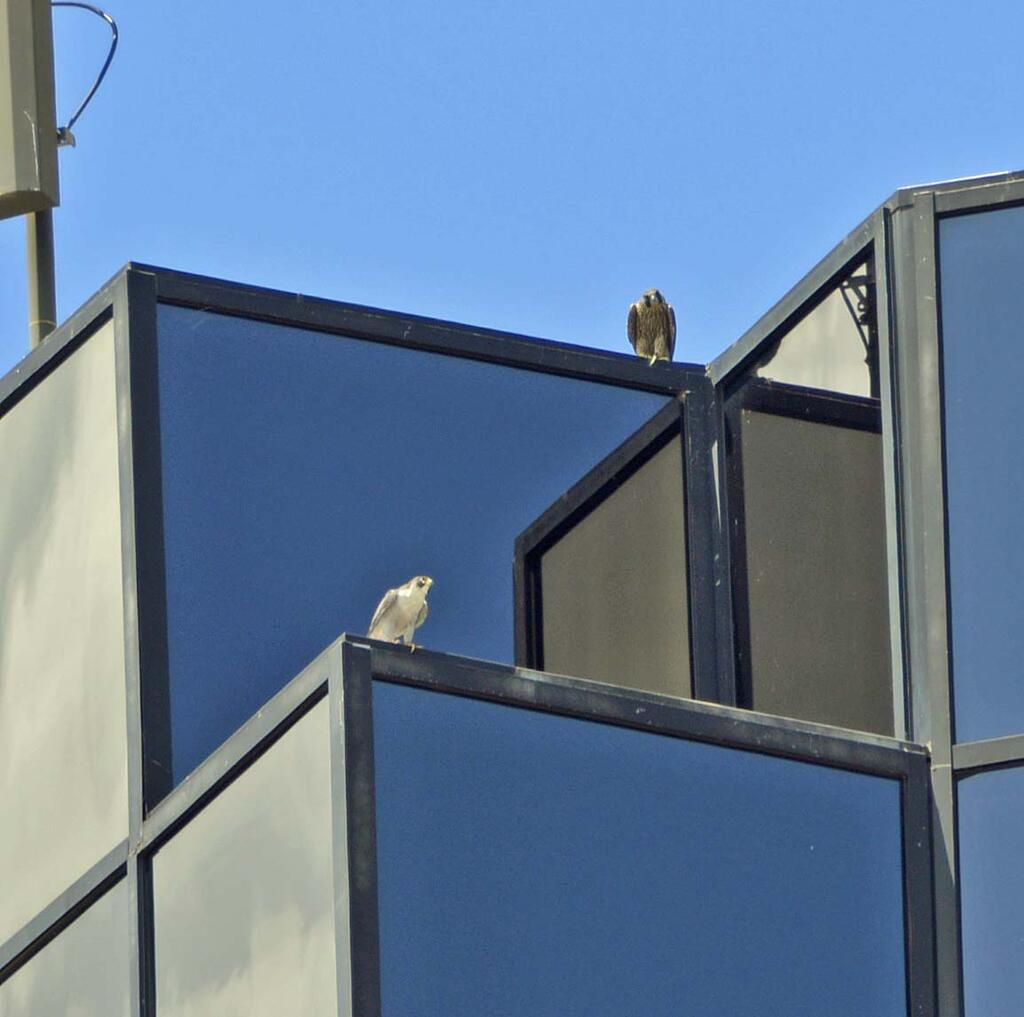
July 05, 2014 - Toronto - Sheraton Centre
Mark Nash Reports:
The best is yet to come!!! Photographers get your camera’s!!!
Remember that the family rearing process is far from being over, as its now dads turn. Over the next 30 plus days, the adult males will be doing most of the flight and hunt training with the fledglings, leaving the resident adult females some time to themselves to catch up on some most needed sleep and de-stress time. WE often see the adult females on the nest ledges doing some est box or nest tray rearranging and sleeping.
The fledglings will still be completely dependant on the adults for food, protection and support for the next 30 to 60 days as they will be staying very close to home around the nest buildings.
We often forget that the fledglings (I guess we can call them juveniles now, as they are the equivalent of teenagers in their mind set), still have no idea that they have actually been eating birds, as their food has been prepared by their parents. Many of the food packages have already had their heads removed, and with many of the feathers already having been removed, and as such, the juveniles have had no idea what they have actually been eating!
Of course its birds and only birds, but the young peregrines must be taught this!
They must be taught how to chase, stoop and dive for things and encouraged to chase their parents for the food. They must be shown what to hunt, how to hunt, how to catch it and how to kill it and then how to prepare it. The fledglings still have a long way to go before they are actually able to catch food themselves!
For the next few weeks, its all fun and games (at least for the fledglings),, but they are actually be taught important life skills that will prepare them for survival on their own this fall.
The fledglings, (juveniles) will succumb to a couple of thousand years to migrate in the fall and they will be on their own.
Most all of the resident territorial nesting adults at our southern Ontario urban nest sites will NOT migrate, and they will stay on territory all year. The adults have learned that you they can survive in the city all year long, (urban adaptation), and have figured out that there is an abundance of food around all year long, ideal habitat, no predation and lots of warmth from the buildings, especially from that of the illuminated signs that they roost on.
But the young of the year will go! Being creatures of habit (almost to a fault), what they know, they deal with,,, what they don’t know, they avoid! So its up to the parents to teach them as much as they can over next two months so the fledglings have the necessary life skills to be able to survive on their own. The fledgling juveniles typically migrate south to central and southern America for the winter months and have a very long trip south with many dangers.
Also remember, that the peregrine has more than an 80% mortality rate until it reaches breeding age (typically between two and three years of age), with the higher percentage of this mortality happening in the first year of their lives.
For all of the photographers out there, this is the best opportunity for some incredible photos of the adults training the fledglings over the next 30 plus days!! This is the time to really enjoy your peregrines,, so get out there with your cameras and spend some time with them!
Posted on July 5, 2014 12:06 pm
July 05, 2014 - Toronto - King Street
Mark Nash Reports:
The best is yet to come!!! Photographers get your camera’s!!!
Remember that the family rearing process is far from being over, as its now dads turn. Over the next 30 plus days, the adult males will be doing most of the flight and hunt training with the fledglings, leaving the resident adult females some time to themselves to catch up on some most needed sleep and de-stress time. WE often see the adult females on the nest ledges doing some est box or nest tray rearranging and sleeping.
The fledglings will still be completely dependant on the adults for food, protection and support for the next 30 to 60 days as they will be staying very close to home around the nest buildings.
We often forget that the fledglings (I guess we can call them juveniles now, as they are the equivalent of teenagers in their mind set), still have no idea that they have actually been eating birds, as their food has been prepared by their parents. Many of the food packages have already had their heads removed, and with many of the feathers already having been removed, and as such, the juveniles have had no idea what they have actually been eating!
Of course its birds and only birds, but the young peregrines must be taught this!
They must be taught how to chase, stoop and dive for things and encouraged to chase their parents for the food. They must be shown what to hunt, how to hunt, how to catch it and how to kill it and then how to prepare it. The fledglings still have a long way to go before they are actually able to catch food themselves!
For the next few weeks, its all fun and games (at least for the fledglings),, but they are actually be taught important life skills that will prepare them for survival on their own this fall.
The fledglings, (juveniles) will succumb to a couple of thousand years to migrate in the fall and they will be on their own.
Most all of the resident territorial nesting adults at our southern Ontario urban nest sites will NOT migrate, and they will stay on territory all year. The adults have learned that you they can survive in the city all year long, (urban adaptation), and have figured out that there is an abundance of food around all year long, ideal habitat, no predation and lots of warmth from the buildings, especially from that of the illuminated signs that they roost on.
But the young of the year will go! Being creatures of habit (almost to a fault), what they know, they deal with,,, what they don’t know, they avoid! So its up to the parents to teach them as much as they can over next two months so the fledglings have the necessary life skills to be able to survive on their own. The fledgling juveniles typically migrate south to central and southern America for the winter months and have a very long trip south with many dangers.
Also remember, that the peregrine has more than an 80% mortality rate until it reaches breeding age (typically between two and three years of age), with the higher percentage of this mortality happening in the first year of their lives.
For all of the photographers out there, this is the best opportunity for some incredible photos of the adults training the fledglings over the next 30 plus days!! This is the time to really enjoy your peregrines,, so get out there with your cameras and spend some time with them!
Posted on July 5, 2014 12:05 pm
July 05, 2014 - Toronto - Don Mills and Eglinton - Amexon
Mark Nash Reports:
The best is yet to come!!! Photographers get your camera’s!!!
Remember that the family rearing process is far from being over, as its now dads turn. Over the next 30 plus days, the adult males will be doing most of the flight and hunt training with the fledglings, leaving the resident adult females some time to themselves to catch up on some most needed sleep and de-stress time. WE often see the adult females on the nest ledges doing some est box or nest tray rearranging and sleeping.
The fledglings will still be completely dependant on the adults for food, protection and support for the next 30 to 60 days as they will be staying very close to home around the nest buildings.
We often forget that the fledglings (I guess we can call them juveniles now, as they are the equivalent of teenagers in their mind set), still have no idea that they have actually been eating birds, as their food has been prepared by their parents. Many of the food packages have already had their heads removed, and with many of the feathers already having been removed, and as such, the juveniles have had no idea what they have actually been eating!
Of course its birds and only birds, but the young peregrines must be taught this!
They must be taught how to chase, stoop and dive for things and encouraged to chase their parents for the food. They must be shown what to hunt, how to hunt, how to catch it and how to kill it and then how to prepare it. The fledglings still have a long way to go before they are actually able to catch food themselves!
For the next few weeks, its all fun and games (at least for the fledglings),, but they are actually be taught important life skills that will prepare them for survival on their own this fall.
The fledglings, (juveniles) will succumb to a couple of thousand years to migrate in the fall and they will be on their own.
Most all of the resident territorial nesting adults at our southern Ontario urban nest sites will NOT migrate, and they will stay on territory all year. The adults have learned that you they can survive in the city all year long, (urban adaptation), and have figured out that there is an abundance of food around all year long, ideal habitat, no predation and lots of warmth from the buildings, especially from that of the illuminated signs that they roost on.
But the young of the year will go! Being creatures of habit (almost to a fault), what they know, they deal with,,, what they don’t know, they avoid! So its up to the parents to teach them as much as they can over next two months so the fledglings have the necessary life skills to be able to survive on their own. The fledgling juveniles typically migrate south to central and southern America for the winter months and have a very long trip south with many dangers.
Also remember, that the peregrine has more than an 80% mortality rate until it reaches breeding age (typically between two and three years of age), with the higher percentage of this mortality happening in the first year of their lives.
For all of the photographers out there, this is the best opportunity for some incredible photos of the adults training the fledglings over the next 30 plus days!! This is the time to really enjoy your peregrines,, so get out there with your cameras and spend some time with them!
Posted on July 5, 2014 12:04 pm
July 05, 2014 - Toronto - Don Mills
Mark Nash Reports:
The best is yet to come!!! Photographers get your camera’s!!!
Remember that the family rearing process is far from being over, as its now dads turn. Over the next 30 plus days, the adult males will be doing most of the flight and hunt training with the fledglings, leaving the resident adult females some time to themselves to catch up on some most needed sleep and de-stress time. WE often see the adult females on the nest ledges doing some est box or nest tray rearranging and sleeping.
The fledglings will still be completely dependant on the adults for food, protection and support for the next 30 to 60 days as they will be staying very close to home around the nest buildings.
We often forget that the fledglings (I guess we can call them juveniles now, as they are the equivalent of teenagers in their mind set), still have no idea that they have actually been eating birds, as their food has been prepared by their parents. Many of the food packages have already had their heads removed, and with many of the feathers already having been removed, and as such, the juveniles have had no idea what they have actually been eating!
Of course its birds and only birds, but the young peregrines must be taught this!
They must be taught how to chase, stoop and dive for things and encouraged to chase their parents for the food. They must be shown what to hunt, how to hunt, how to catch it and how to kill it and then how to prepare it. The fledglings still have a long way to go before they are actually able to catch food themselves!
For the next few weeks, its all fun and games (at least for the fledglings),, but they are actually be taught important life skills that will prepare them for survival on their own this fall.
The fledglings, (juveniles) will succumb to a couple of thousand years to migrate in the fall and they will be on their own.
Most all of the resident territorial nesting adults at our southern Ontario urban nest sites will NOT migrate, and they will stay on territory all year. The adults have learned that you they can survive in the city all year long, (urban adaptation), and have figured out that there is an abundance of food around all year long, ideal habitat, no predation and lots of warmth from the buildings, especially from that of the illuminated signs that they roost on.
But the young of the year will go! Being creatures of habit (almost to a fault), what they know, they deal with,,, what they don’t know, they avoid! So its up to the parents to teach them as much as they can over next two months so the fledglings have the necessary life skills to be able to survive on their own. The fledgling juveniles typically migrate south to central and southern America for the winter months and have a very long trip south with many dangers.
Also remember, that the peregrine has more than an 80% mortality rate until it reaches breeding age (typically between two and three years of age), with the higher percentage of this mortality happening in the first year of their lives.
For all of the photographers out there, this is the best opportunity for some incredible photos of the adults training the fledglings over the next 30 plus days!! This is the time to really enjoy your peregrines,, so get out there with your cameras and spend some time with them!!
Posted on July 5, 2014 12:02 pm
July 05, 2014 - Toronto - Canada Square Building - Yonge and Eglinton
Mark Nash Reports:
The best is yet to come!!! Photographers get your camera’s!!!
Remember that the family rearing process is far from being over, as its now dads turn. Over the next 30 plus days, the adult males will be doing most of the flight and hunt training with the fledglings, leaving the resident adult females some time to themselves to catch up on some most needed sleep and de-stress time. WE often see the adult females on the nest ledges doing some est box or nest tray rearranging and sleeping.
The fledglings will still be completely dependant on the adults for food, protection and support for the next 30 to 60 days as they will be staying very close to home around the nest buildings.
We often forget that the fledglings (I guess we can call them juveniles now, as they are the equivalent of teenagers in their mind set), still have no idea that they have actually been eating birds, as their food has been prepared by their parents. Many of the food packages have already had their heads removed, and with many of the feathers already having been removed, and as such, the juveniles have had no idea what they have actually been eating!
Of course its birds and only birds, but the young peregrines must be taught this!
They must be taught how to chase, stoop and dive for things and encouraged to chase their parents for the food. They must be shown what to hunt, how to hunt, how to catch it and how to kill it and then how to prepare it. The fledglings still have a long way to go before they are actually able to catch food themselves!
For the next few weeks, its all fun and games (at least for the fledglings),, but they are actually be taught important life skills that will prepare them for survival on their own this fall.
The fledglings, (juveniles) will succumb to a couple of thousand years to migrate in the fall and they will be on their own.
Most all of the resident territorial nesting adults at our southern Ontario urban nest sites will NOT migrate, and they will stay on territory all year. The adults have learned that you they can survive in the city all year long, (urban adaptation), and have figured out that there is an abundance of food around all year long, ideal habitat, no predation and lots of warmth from the buildings, especially from that of the illuminated signs that they roost on.
But the young of the year will go! Being creatures of habit (almost to a fault), what they know, they deal with,,, what they don’t know, they avoid! So its up to the parents to teach them as much as they can over next two months so the fledglings have the necessary life skills to be able to survive on their own. The fledgling juveniles typically migrate south to central and southern America for the winter months and have a very long trip south with many dangers.
Also remember, that the peregrine has more than an 80% mortality rate until it reaches breeding age (typically between two and three years of age), with the higher percentage of this mortality happening in the first year of their lives.
For all of the photographers out there, this is the best opportunity for some incredible photos of the adults training the fledglings over the next 30 plus days!! This is the time to really enjoy your peregrines,, so get out there with your cameras and spend some time with them!
Posted on July 5, 2014 12:01 pm
July 05, 2014 - Mississauga - Executive Centre
Mark Nash Reports:
The best is yet to come!!! Photographers get your camera’s!!!
Remember that the family rearing process is far from being over, as its now dads turn. Over the next 30 plus days, the adult males will be doing most of the flight and hunt training with the fledglings, leaving the resident adult females some time to themselves to catch up on some most needed sleep and de-stress time. WE often see the adult females on the nest ledges doing some est box or nest tray rearranging and sleeping.
The fledglings will still be completely dependant on the adults for food, protection and support for the next 30 to 60 days as they will be staying very close to home around the nest buildings.
We often forget that the fledglings (I guess we can call them juveniles now, as they are the equivalent of teenagers in their mind set), still have no idea that they have actually been eating birds, as their food has been prepared by their parents. Many of the food packages have already had their heads removed, and with many of the feathers already having been removed, and as such, the juveniles have had no idea what they have actually been eating!
Of course its birds and only birds, but the young peregrines must be taught this!
They must be taught how to chase, stoop and dive for things and encouraged to chase their parents for the food. They must be shown what to hunt, how to hunt, how to catch it and how to kill it and then how to prepare it. The fledglings still have a long way to go before they are actually able to catch food themselves!
For the next few weeks, its all fun and games (at least for the fledglings),, but they are actually be taught important life skills that will prepare them for survival on their own this fall.
The fledglings, (juveniles) will succumb to a couple of thousand years to migrate in the fall and they will be on their own.
Most all of the resident territorial nesting adults at our southern Ontario urban nest sites will NOT migrate, and they will stay on territory all year. The adults have learned that you they can survive in the city all year long, (urban adaptation), and have figured out that there is an abundance of food around all year long, ideal habitat, no predation and lots of warmth from the buildings, especially from that of the illuminated signs that they roost on.
But the young of the year will go! Being creatures of habit (almost to a fault), what they know, they deal with,,, what they don’t know, they avoid! So its up to the parents to teach them as much as they can over next two months so the fledglings have the necessary life skills to be able to survive on their own. The fledgling juveniles typically migrate south to central and southern America for the winter months and have a very long trip south with many dangers.
Also remember, that the peregrine has more than an 80% mortality rate until it reaches breeding age (typically between two and three years of age), with the higher percentage of this mortality happening in the first year of their lives.
For all of the photographers out there, this is the best opportunity for some incredible photos of the adults training the fledglings over the next 30 plus days!! This is the time to really enjoy your peregrines,, so get out there with your cameras and spend some time with them!
Posted on July 5, 2014 12:00 pm
July 05, 2014 - Etobicoke - William Osler
Mark Nash Reports:
The best is yet to come!!! Photographers get your camera’s!!!
Remember that the family rearing process is far from being over, as its now dads turn. Over the next 30 plus days, the adult males will be doing most of the flight and hunt training with the fledglings, leaving the resident adult females some time to themselves to catch up on some most needed sleep and de-stress time. WE often see the adult females on the nest ledges doing some est box or nest tray rearranging and sleeping.
The fledglings will still be completely dependant on the adults for food, protection and support for the next 30 to 60 days as they will be staying very close to home around the nest buildings.
We often forget that the fledglings (I guess we can call them juveniles now, as they are the equivalent of teenagers in their mind set), still have no idea that they have actually been eating birds, as their food has been prepared by their parents. Many of the food packages have already had their heads removed, and with many of the feathers already having been removed, and as such, the juveniles have had no idea what they have actually been eating!
Of course its birds and only birds, but the young peregrines must be taught this!
They must be taught how to chase, stoop and dive for things and encouraged to chase their parents for the food. They must be shown what to hunt, how to hunt, how to catch it and how to kill it and then how to prepare it. The fledglings still have a long way to go before they are actually able to catch food themselves!
For the next few weeks, its all fun and games (at least for the fledglings),, but they are actually be taught important life skills that will prepare them for survival on their own this fall.
The fledglings, (juveniles) will succumb to a couple of thousand years to migrate in the fall and they will be on their own.
Most all of the resident territorial nesting adults at our southern Ontario urban nest sites will NOT migrate, and they will stay on territory all year. The adults have learned that you they can survive in the city all year long, (urban adaptation), and have figured out that there is an abundance of food around all year long, ideal habitat, no predation and lots of warmth from the buildings, especially from that of the illuminated signs that they roost on.
But the young of the year will go! Being creatures of habit (almost to a fault), what they know, they deal with,,, what they don’t know, they avoid! So its up to the parents to teach them as much as they can over next two months so the fledglings have the necessary life skills to be able to survive on their own. The fledgling juveniles typically migrate south to central and southern America for the winter months and have a very long trip south with many dangers.
Also remember, that the peregrine has more than an 80% mortality rate until it reaches breeding age (typically between two and three years of age), with the higher percentage of this mortality happening in the first year of their lives.
For all of the photographers out there, this is the best opportunity for some incredible photos of the adults training the fledglings over the next 30 plus days!! This is the time to really enjoy your peregrines,, so get out there with your cameras and spend some time with them!
Posted on July 5, 2014 12:00 pm
July 05, 2014 - Etobicoke - Sun Life Centre
Mark Nash Reports:
The best is yet to come!!! Photographers get your camera’s!!!
Remember that the family rearing process is far from being over, as its now dads turn. Over the next 30 plus days, the adult males will be doing most of the flight and hunt training with the fledglings, leaving the resident adult females some time to themselves to catch up on some most needed sleep and de-stress time. WE often see the adult females on the nest ledges doing some est box or nest tray rearranging and sleeping.
The fledglings will still be completely dependant on the adults for food, protection and support for the next 30 to 60 days as they will be staying very close to home around the nest buildings.
We often forget that the fledglings (I guess we can call them juveniles now, as they are the equivalent of teenagers in their mind set), still have no idea that they have actually been eating birds, as their food has been prepared by their parents. Many of the food packages have already had their heads removed, and with many of the feathers already having been removed, and as such, the juveniles have had no idea what they have actually been eating!
Of course its birds and only birds, but the young peregrines must be taught this!
They must be taught how to chase, stoop and dive for things and encouraged to chase their parents for the food. They must be shown what to hunt, how to hunt, how to catch it and how to kill it and then how to prepare it. The fledglings still have a long way to go before they are actually able to catch food themselves!
For the next few weeks, its all fun and games (at least for the fledglings),, but they are actually be taught important life skills that will prepare them for survival on their own this fall.
The fledglings, (juveniles) will succumb to a couple of thousand years to migrate in the fall and they will be on their own.
Most all of the resident territorial nesting adults at our southern Ontario urban nest sites will NOT migrate, and they will stay on territory all year. The adults have learned that you they can survive in the city all year long, (urban adaptation), and have figured out that there is an abundance of food around all year long, ideal habitat, no predation and lots of warmth from the buildings, especially from that of the illuminated signs that they roost on.
But the young of the year will go! Being creatures of habit (almost to a fault), what they know, they deal with,,, what they don’t know, they avoid! So its up to the parents to teach them as much as they can over next two months so the fledglings have the necessary life skills to be able to survive on their own. The fledgling juveniles typically migrate south to central and southern America for the winter months and have a very long trip south with many dangers.
Also remember, that the peregrine has more than an 80% mortality rate until it reaches breeding age (typically between two and three years of age), with the higher percentage of this mortality happening in the first year of their lives.
For all of the photographers out there, this is the best opportunity for some incredible photos of the adults training the fledglings over the next 30 plus days!! This is the time to really enjoy your peregrines,, so get out there with your cameras and spend some time with them!
Posted on July 5, 2014 11:58 am
July 04, 2014 - Scarborough - Yellow Pages
Marion Nash Reports:
June 4th - 2014
I can’t think of a slower day, especially for fledglings that are now 50 plus days old!! Its been over a week now on the Scarborough fledge watch and we don’t seem to be any further ahead :-), at least with the two young female fledglings, - Tormey and Petra-Fire!
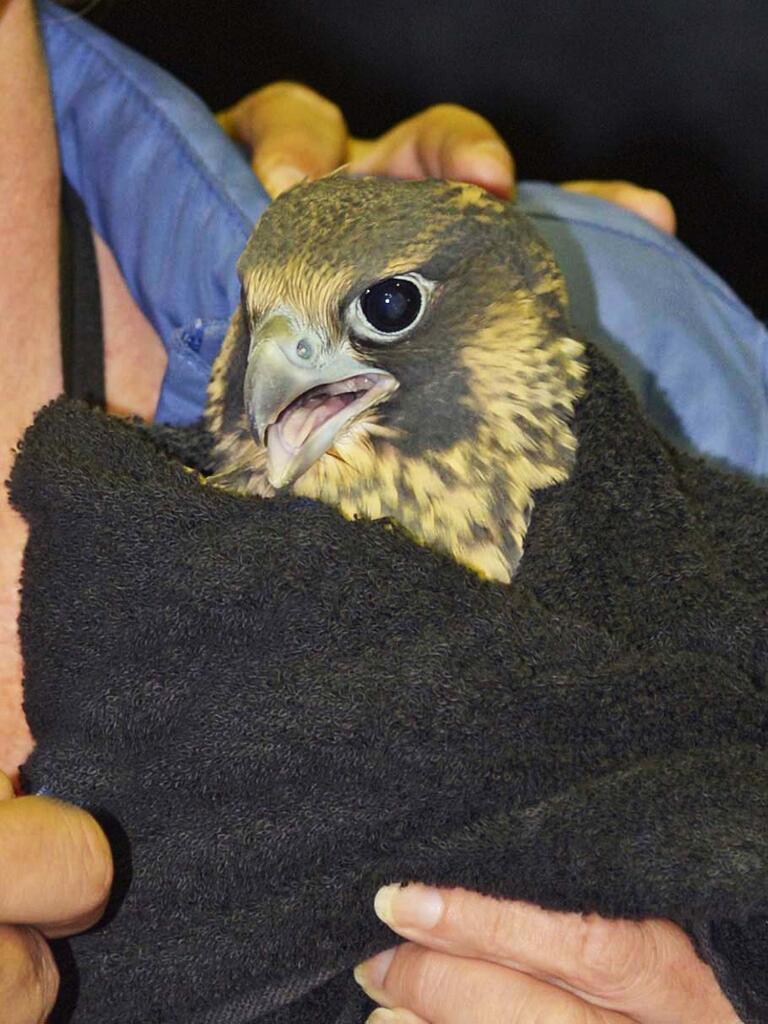
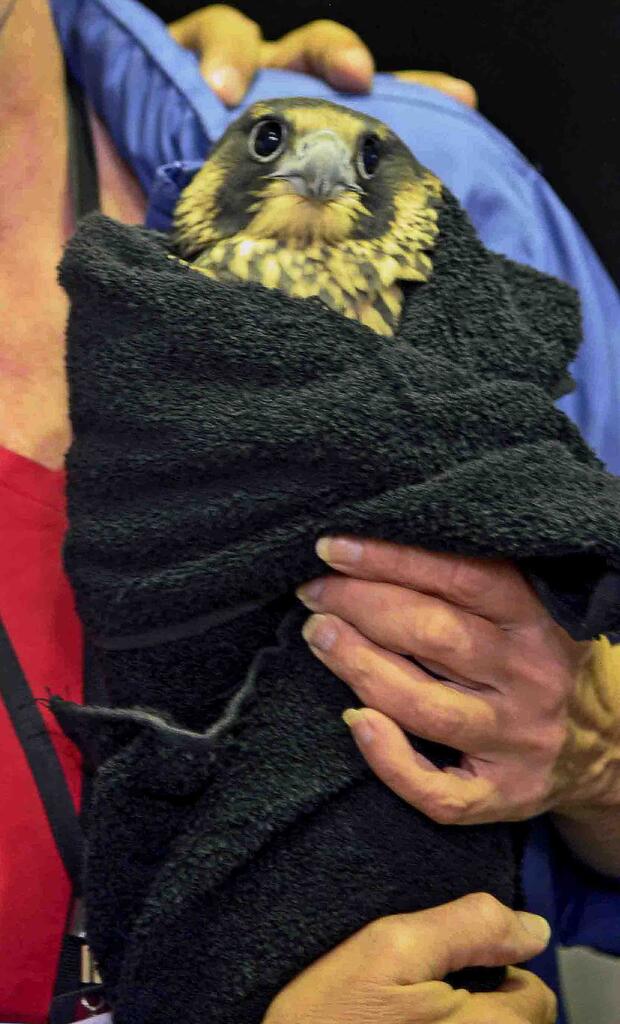
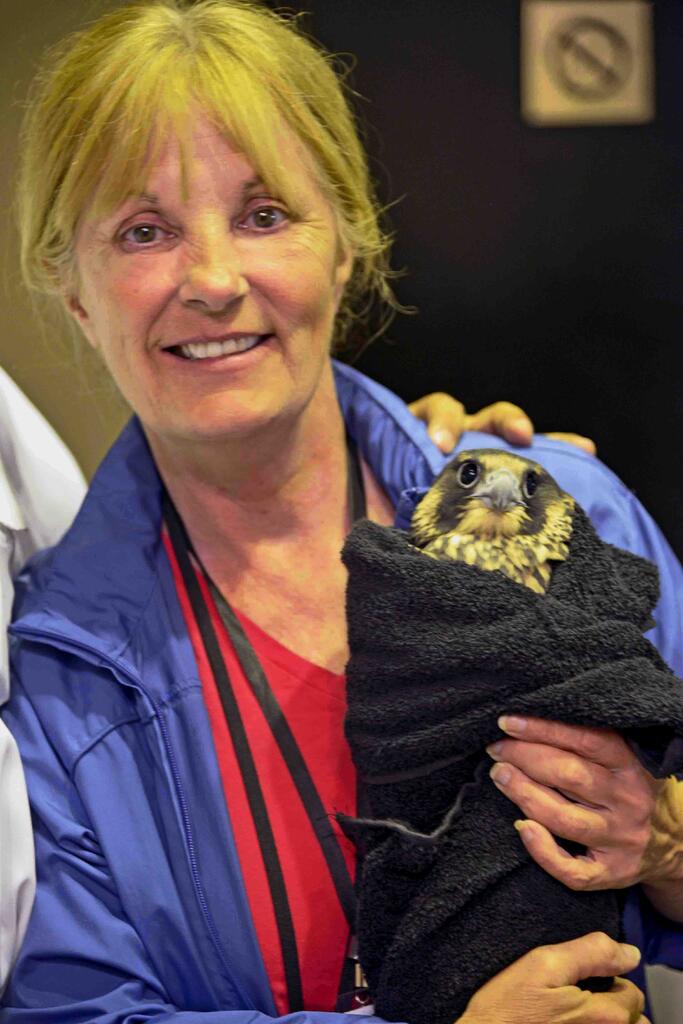
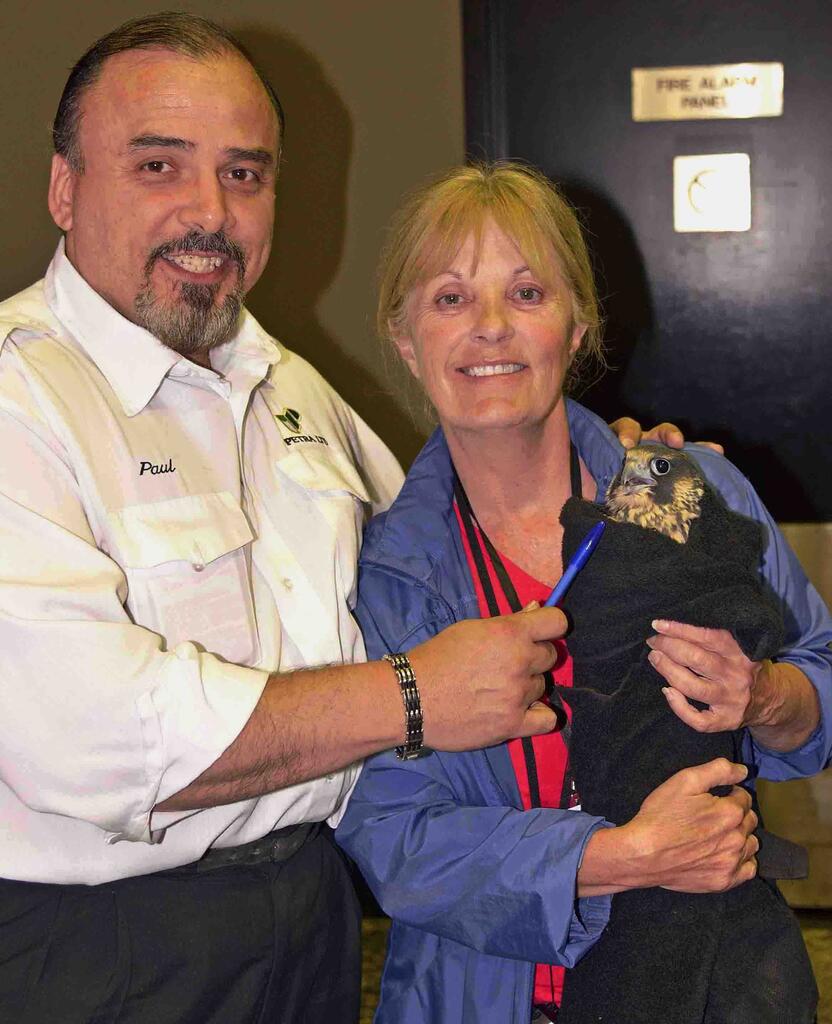
Petra was released back on the roof top today as she checked out healthy and fit after being rescued from the ground yesterday by Marion and Michael. Given that there were other fledglings on the upper roof elevation and fearing that we may spook the others into a panic flight if she was released at this time, Petra spent the evening in a carrier at security. A wise decision anyway, so she could be observed much closer to ensure that she had not been injured in her hard meeting with the concrete. A hold-over is always a wise idea to insure that undetected traumas don’t manifest. A final examination was completed prior to her release.
After her release, she decided to have a restful day sitting up on the roof top all day long. Her sister, Tormey also sat like a gargoyle most of the day having not left the ledge she had flown to yesterday. Even Loran spent a lazy day with only a couple short flights, but for the most parts all three juveniles and both parents didn’t do allot of flying at all. Can’t figure it out, it was a great day, much cooler from the debilitating heat and humidity that we have all been through this past few days!
There were constant cool breezes all day and what we would have expected to be perfect flying conditions for all, but this was not the case today. While the little fledgling male (named Lorne) is flying very good, the two girls have yet to take their first real flights away from the building.
Linn - (Mom) went after a gull today with some spectacular stoops and dives seemingly without any provocation and chased it clear out of sight to the south east of the nest building. Don’t know what was up with that, as over the past week while we have been on the fledge watch out here at Yellow Pages, both adults have not given any of the gulls any attention, even the ones that were flying only several feet above the building rooftop.
At one point earlier on in the week, a gull repeatedly stooped one of the young fledglings right in front of the adults, and they didn’t give it a second look and just watched the gull stoop the juvenile.
Otherwise it was a very quite an uneventful day on the watch for all of us. It was so slow today, we are all starting to count windows on the building to keep us occupied and awake  We’re all going to compare window counts later on this weekend. Oh my goodness, HELP US STAY AWAKE!
We were joined by Patty for a couple of hours this afternoon who was able to get a few photos with her new 500mm lens. Michael also joined us for a short time today who brought out his 800mm lens to snap a few photos of the fledglings.
By 8pm, it was quite apparent that everyone was tucked in for the evening and absolutely no activity was observed by the time we closed the fledge watch shift down for the evening. We all departed by 9:05pm and departed fro home.
A big thank you to Dave and Bonny for coming out and helping us at the fledge watch today, and to Paul from Petra for getting us to the upper roof elevation to release little Petra-fire back to her parents.
Stay tuned, we’ll be back out again tomorrow…..
Posted on July 5, 2014 11:29 am
July 04, 2014 - Toronto - Canada Square Building - Yonge and Eglinton
Marion Nash Reports:
I sat out for over two hours today and had brief glimpses of the Canada Square peregrine family. I was lucky enough to see all five at once !
Malik was on Rio-Can (RC)when I arrived but flew shortly after that. Haven flew in and perched. A few minutes later Malik returned and the two of them spent almost the two hours there. A juvenile flew from somewhere at the north end of the apartment building at 411 Duplex Ave went around the east side of RC, south and circled over Canada Square before flying back to RC.
The *twosome* then took to the air briefly and disappeared over RC.
Finally I had Haven and Malik still on RC and the *twosome* in tandem, with the third one close by over RC. I saw brief interaction between the solo flier and one of the *twosome* - they talon touched and then one of them flew up Duplex Ave to the apartment building at 500 Duplex. I know I always have the number wrong but it is the first tall building on the west side above Eglinton. The little guy flew to the antenna on top if the building.
There was a brief lull in activity and then I saw another juvie flying to the same building, join the juvie there and they flew together.
That was it. A brief encounter in the late afternoon. I was chatting to a friend and when I looked up later on, both Malik and Haven had flown so I came home.
All three juvies are flying well and when flying with the wind they are fast! Thank goodness they do that above the buildings!
Lyn
Posted on July 5, 2014 10:06 am