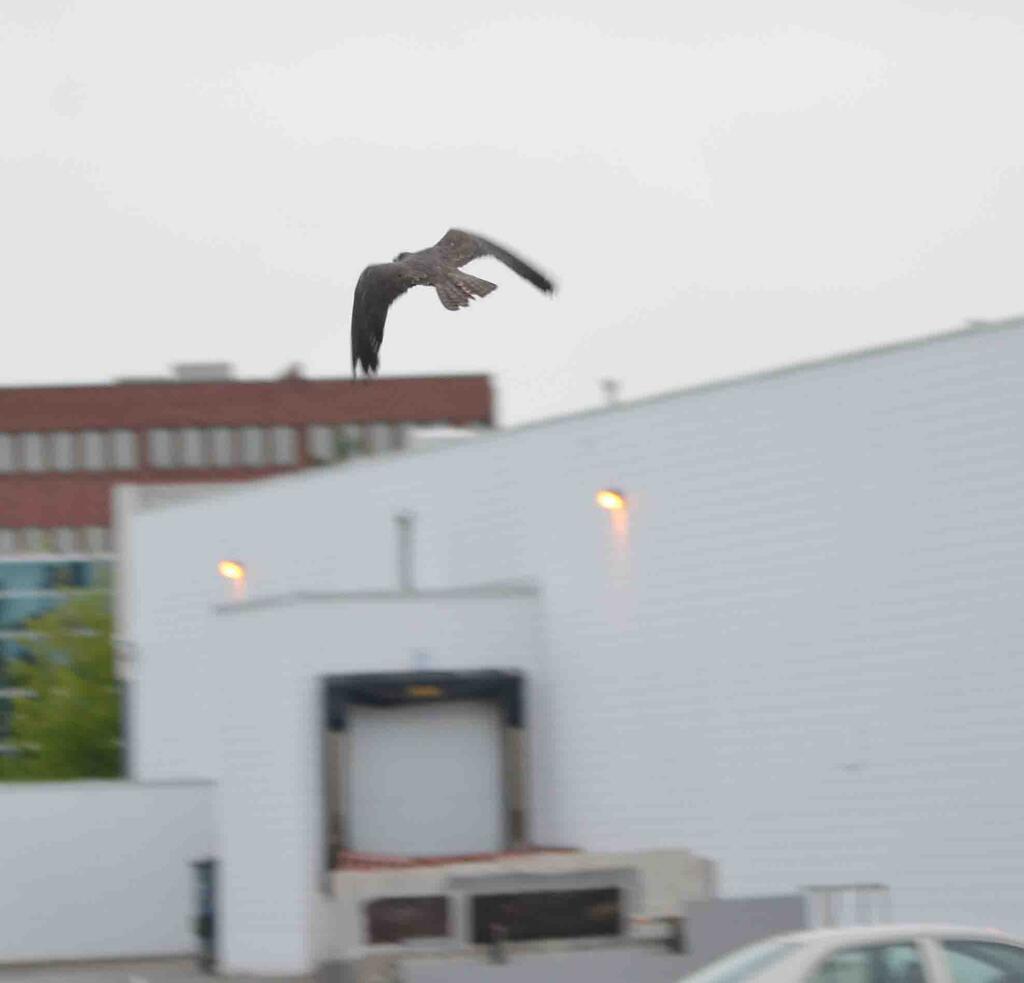
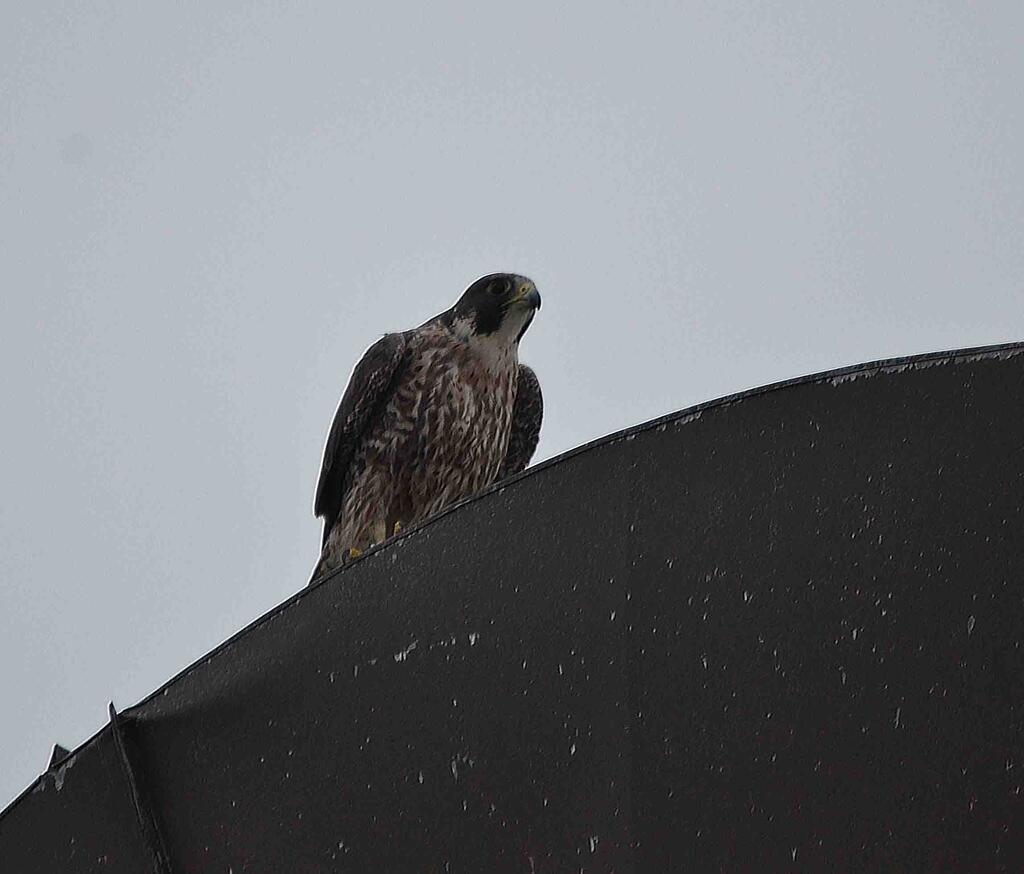
May 30, 2011 - Brampton - Courthouse
Tracy Simpson Reports:
For all of the folks that have been looking for past postings and were unable to locate them, I have reposted them to the new Brampton Courthouse page for your reading. The dates will be bolded for ease of locating them.
On Monday May 30th, I was on-site at the Brampton Courthouse to confirm my recent sighting of the peregrine pair in an change over at their selected southwest ledge. I entered the building and once I was through the security checks, I was able to meet with Ed Czuchnicki, the Senior Facility Manager Central Region Zone A for CB Richard Ellis Ltd, ORC Property and Land Management Services. I was pleasantly surprised to hear how excited the staff at the courthouse were to have a pair of peregrine falcons nesting on their building. According to Mr. Czuchnicki and his staff, this is the second year that the birds have nested at this site. I was able to gain access with Mr. Czucknicki to the window that overlooks the area in which I suspected that the birds were nesting and was rewarded with a view of Milton, the resident male, in incubation on the ledge. Milton then stood up and gave me the opportunity to view the two eggs that he was diligently caring for!! This is certainly exciting news as there has been a change in resident females since the territory was first occupied in the early spring. Initially the resident female was unbanded as can be seen in photographs taken back in March. The current resident female is Truss, a 2009 hatch from the Burlington Lift Bridge. The CPF will be working with our latest peregrine supporters at the Brampton Courthouse to make this nest site a huge success for all in 2011.
Posted on June 4, 2011 6:46 pm
May 27, 2011 - Brampton - Courthouse
Tracy Simpson Reports:
This was another of the earlier posts that were dropped when we updated our system. I apologize for the missing post but here it is. I have bolded the date for ease of reference.
May 27th - I was on-site at the Brampton Courthouse today to look for activity at the site. The resident male, Milton, was roosting on the southwest corner of the sub-roof. Within 10 minutes he flew off and landed on the same ledge just a few metres north and disappeared. Moments later he emerged with food and took it to the southwest corner one ledge below where he was roosting. As he landed, the female popped up, took the food and left that ledge to go to the sub-roof and eat. As Truss, the resident female, took off the male jumped down into the ledge and disappeared. With only one adult being seen at a time, their behavior and the change off that I witnessed all point to the incubation of something. I will be on-site early next week to see if I can get a view of that ledge and ascertain just what the resident pair are looking after there.
Posted on May 27, 2011 6:45 pm
May 26, 2011 - International, National and Local News
Marion Nash Reports:
May 26-2011
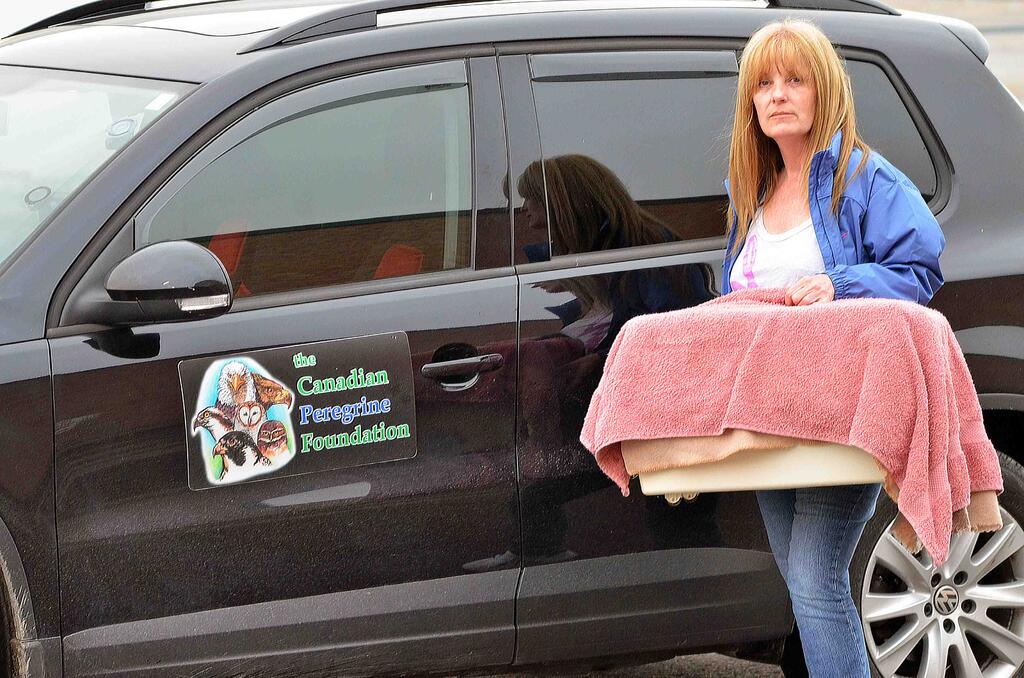
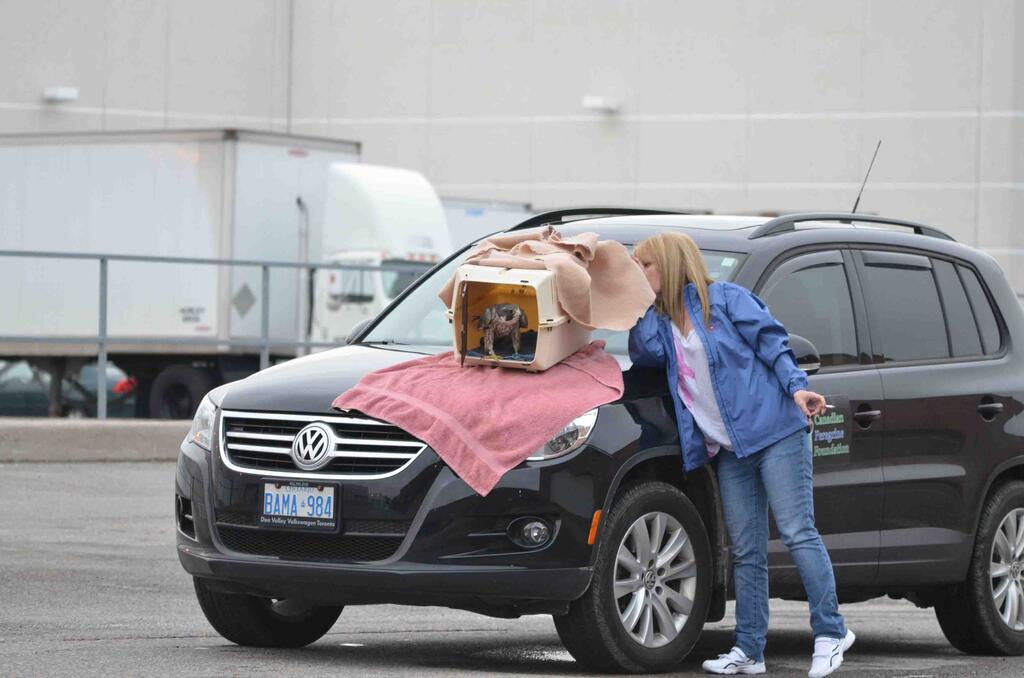
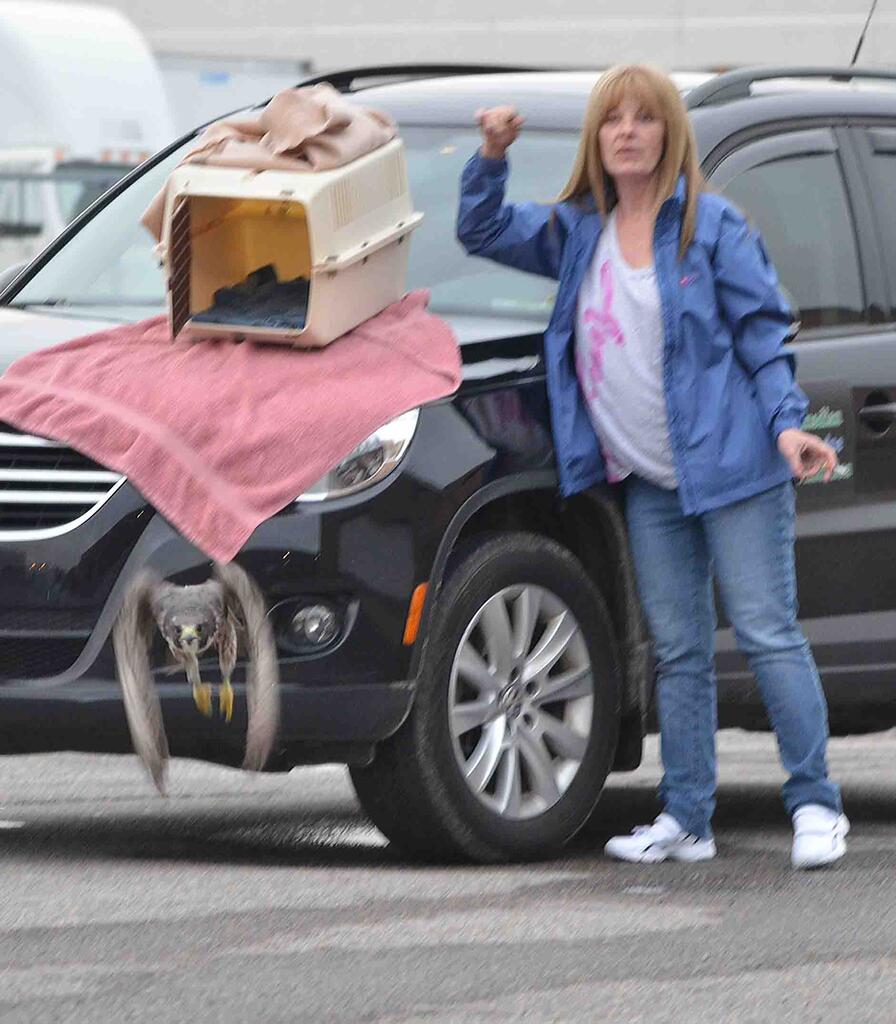
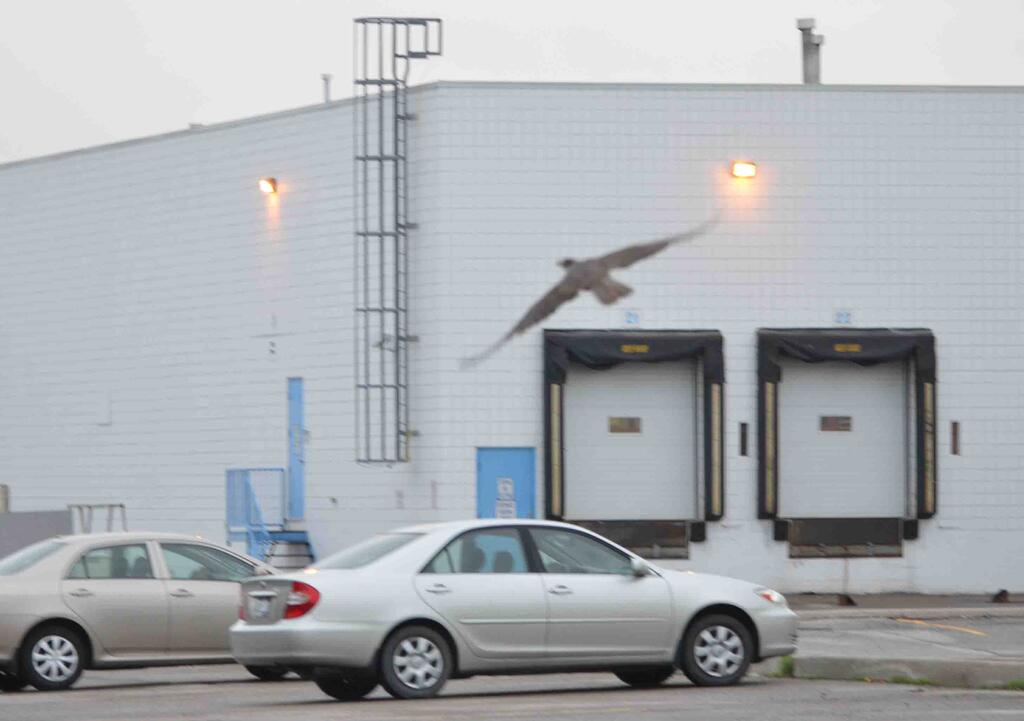
In the early evening of Thursday May 26th just after the heavy rains, Mark and Marion said farewell to Statler with a successful release. Statler, (or Lucky as she was nic-named) was rescued from an air vent at the Rogers centre over the long weekend and was after a short hold over to rehydrate and feed her, was released back to the wild in Richmond Hill on west Bevercreek Rd.
Typical of what we are usually faced with, this rescue took place during a long weekend (at the worst of times) when we struggle to find anyone (other than CPF people) to help!
As Marion reports:
I tried to hide behind the towel on the carrier after opening the door but she knew I was there and peeked around the corner of the rescue carrier to see what I was up to before taking her freedom flight. It took her a few minutes to walk out of the carrier and take to the air with strong wing beats and steady flight. She made it up to yer another air vent on the top of a low rise industrial building only several meters in front of us. Both of hearts sunk as she landed on the top of a huge air intake vent,, - (OH MY GOD, NOT ANOTHER AIR VENT)!! She took several minutes to get her bearings before she finally flew off to the west, gaining good altitude and hooked around to the south and out of our view.
Good for her! I hope the next time we meet this big girl it will be at the banding of her offspring. Lets hope that she has learned something from this, as she does seem to favour hanging around on air vent,, s so lets keep our fingers crossed.
Posted on May 27, 2011 2:30 pm
- International, National and Local News
Frank Butson Reports:
By CBC News, cbc.ca, Updated: May 24, 2011 1:47 PM
Rare falcons move into Sudbury mine sites
Peregrine falcons are nesting in open pit mines and an abandoned ore plant near Sudbury, Ont.
The nesting sites are located on property owned by mining giant Vale, which has been forced to alter some of its plans to accommodate the birds, listed as a threatened species under Ontario’s Endangered Species Act.
“Interestingly enough, they’ve picked this beauty of a building,” said Alison Merla, a senior environmental analyst with Vale, as she pointed out the crumbling structure of brick, rusty metal and broken windows where a pair of peregrine falcons has nested each year since 2008.
The company wants to demolish the building, a former ore recovery plant, saying it poses a health and safety hazard to both humans and the birds.
The demolition is on hold because of requirements under Ontario endangered species legislation to protect the birds.
The company has put up two nest boxes on a nearby smokestack, which will continue to be used for nickel refining, in the hopes that the birds will move.
“They’ve started perching in the area of those nesting boxes this year, which is fantastic news,” Merla said.
“We haven’t been able to confirm that they are inside and nesting, but that their showing interest is definitely positive.”
Vale is also planning to discourage the birds from nesting in the building by covering the windows and ledges with snow fencing.
Provincial endangered species legislation bars the company from harming or killing the birds, said Eric Cobb, a species at risk biologist with the Sudbury district of Ontario’s Ministry of Natural Resources.
“If the birds do try to nest despite the harassment, then they have to be left alone,” he said.
Once the birds have finished nesting, Vale is free to demolish the building.
Merla said the company is also monitoring falcons nesting in some of the company’s open pit mines, with help from a Laurentian University biologist. Currently, no mining is being done at those particular sites. If work does begin, the company will need a special permit from the Ministry of Natural Resources.
Urban nests
Cobb said it’s not surprising the birds have chosen the mines, as they resemble the natural cliffs where the falcons traditionally nested.
He added that the species has shown some tolerance to human activity. They have nested successfully in highrises in cities like Toronto and Ottawa, and there is a pair nesting this year under Windsor’s Ambassador Bridge.
Merla noted that the species has now been downgraded from endangered to threatened status.
“One of the reasons that they’ve managed to make such a big comeback,” she said, “is largely due to their adaptability.”
In the Sudbury area, she also credited Vale’s efforts to restore local habitat, creating attractive hunting grounds for the birds.
With files from Megan Thomas
External Links
Ontario Endangered Species Act
Peregrine Falcon fact sheet from Ontario Ministry of Natural Resources (PDF)
Posted on May 26, 2011 12:07 pm
- All Reports
Tracy Simpson Reports:
I was on my way to the CPF head office on Friday and almost turned around. Nest sites to check in on and so much field work to do I didn’t have time for admin work, but I was close so I stopped in anyways. This was the beginning of a rescue operation that were it not for pure luck and several groups working together, it would not have ever happened.
Shortly after arriving at the office, I received a phone call from a gentleman named Dale Kurt, a Branch Manager for Orkin PCO Services, who was calling to report a peregrine falcon in trouble. It would seem that this bird had somehow fallen into a cooling tower and become trapped. Dale had already been on the phone with several other agencies in an attempt to make contact with someone who could help rescue the bird but was unable to make a connection with anyone that could help. Mr. Kurt remembered the CPF from our activities at southern Ontario peregrine nest sites and called our office that afternoon. I was luckily there to answer the call as I was just about to head out into the field to do nest site checks.
According to Dale Kurt, the cooling tower the bird was trapped in was one of several that are a part of the roof system at Rogers Centre in downtown Toronto. On Wednesday May 18th, the staff at Rogers Centre completed an inspection of the tower and found the trapped bird. It was quite fortunate that this maintenance inspection came when it did as the bird had literally just fallen in. Wayne Sills, who works for Rogers Centre and coordinates the staff efforts to keep the mechanics in tip top shape, contacted Dale at Orkin PCO Services to let him know of the discovery of this bird and that the peregrine was clearly unable to fly back out of the tower on its own. Dale headed down to Rogers Centre and met up with Wayne who then took him up through the building to the trapped birds’ location. Knowing that he was looking at a protected species at risk, Dale decided to contact the OMNR regarding a rescue effort and later that afternoon called me.
Throughout my conversation with Dale, it was clearly going to have to been a joint rescue effort as I have never been introduced to the folks at Rogers Centre and I would require access to non-public areas of the building. Dale and I met down at the shipping docks where we were joined by Wayne Sills of Rogers Centre, gathered our needed equipment and headed up to security. I must say that the folks at Rogers Centre were absolutely amazing in guiding and accomodating this rescue effort and they are to be commended for their efforts. An elevator ride, two ladder trips and a few little access hatches later Dale, Wayne and I stood face to face with a very confused sub-adult female peregrine falcon. I have to tell you that Dale is one quick guy with a net!! In less than 60 seconds, the bird was in a rescue carrier and on her way down.
We contacted the OMNR to let them know that we had rescued this female and that she was in need of rehydration, food and rest and then took her back to the CPF Raptor Centre for treatment. In debriefing the situation, we all have realized that on the Friday of a long weekend, that were it not for Wayne Sills and his staff at Rogers Centre, Dale Kurt at Orkin PCO Services and the CPF staff all working together, this bird would not have been found, rescued and cared for. And that’s why her nickname is “Lucky”!!
Continuing along the theme of being the most lucky peregrine falcon that I have ever met, it turns out that “Lucky” was hatched at the Buffalo Statler Tower nest site in 2010 and was one of 5 chicks hatched that year. Due to access issues, the birds could not be banded except for one, the only one to come to the ground and needing a rescue, and she now wears the Black over Green 65/AW that has identified her!! A huge thank you to all that have participated in this grand rescue of a very Lucky bird!! Check back soon for release photos as she is healthy, rehydrated and ready to go!!! Good luck Lucky!!
Posted on May 25, 2011 4:16 pm
- International, National and Local News
Frank Butson Reports:
Published On Mon May 16 2011

A bald eagle soars over Cootes Paradise along Hamilton’s Lake Ontario shore. Two bald eagles are nesting in a tall pine and could be making babies, but experts aren’t hopeful they will have eaglets this year.
JIM WILKES/TORONTO STAR
Jim Wilkes Staff Reporter
It appears there won’t be baby bald eagles along Hamilton’s Lake Ontario shore this year.
A young male eagle and his older female mate have been spotted snuggling in a nest atop a tall white pine in Cootes Paradise marsh throughout the spring.
But all that wooing hasn’t resulted in eggs, said Nick Kondrat of Burlington’s Royal Botanical Gardens.
“Judging the behaviour of the eagles, they’re not bringing food back to the nest,” he said.
“They’re not really hanging around as much as they would if there were young ‘uns in the nest.”
The male just might not be ready to deliver the goods, Kondrat said.
“You can tell by its feather patterns that it’s in the stage where it’s maturing into an adult eagle, but hasn’t quite reached that stage yet,” he explained. “We’re looking forward to next year.”
Had the majestic birds produced a brood, their young could have been the first homegrown bald eagles on the lake’s north shore in 50 years.
A century ago, bald eagles were a common sight along Lake Ontario. But toxic pesticides slowly killed off most of the population.
By 1980, only four bald eagle nests remained in southern Ontario, said Tys Theijsmeijer, RBG’s head of natural lands. There are now about 32 nests, including areas north of Toronto and near Peterborough, he said.
The birds, whose wingspan is more than two metres, were first spotted in the area in 2009 and naturalists have been hoping they’d start breeding to replenish the local eagle numbers.
Posted on May 16, 2011 11:54 pm
May 16, 2011 - International, National and Local News
Frank Butson Reports:
Once nearly extinct, the California condor nears new milestones

 Almost 25 years after the California condor went extinct in the wild and dwindled to just 27 birds in captivity, North America’s largest flying bird is on the verge of a watershed moment: Its total population is projected to hit 400 this spring, including 200 birds thriving in the wild.
The projections come as curators are reporting a successful hatching season at breeding centers in California and elsewhere.
“At the end of the breeding season, we should be at 400 if all goes to projection,” said Michael Mace, curator of birds at the San Diego Zoo Safari Park. “At the end of this year, we could have 200 birds in the wild. Both would be significant milestones.”
The 400 mark hasn’t been seen since the 1920s or 1930s, Mace said.
The condor population is currently 394, including 181 in the wild — a marked improvement since 1987 when the condor was wiped out in the wild and only 27 lived at the San Diego Zoo, he said.
The success hasn’t been without new challenges.
While the nearly 200 birds in the wilderness are resuming feeding activities last seen during the Lewis and Clark Expedition of the early 1800s, the condor is now ingesting the toxin DDE when eating marine carcasses, Mace said.
The toxin causes the shell of condor eggs to thin, so conservationists are replacing the thin-shelled eggs laid in the wild with thicker-shelled eggs from breeding centers, Mace said. The thin-shelled eggs are taken to incubators in breeding facilities for hatching, he said.
“Condors are doing what they normally do: They feed on marine animal carcasses,” Mace said. “We are excited that condors are doing activities that Lewis and Clark observed more than 100 years ago. But it turns out these marine animals are feeding on DDE, and now the condors are feeding on them, and the shells of their eggs are thin and break.”
DDE is formed when the pesticide DDT breaks down. DDT is banned in the United States, but the chemical enters the environment through its use in other countries.
“Some of these factors we’re dealing with right now weren’t factors five, 10 years ago,” Mace said.
For example, California condors are now being vaccinated for the West Nile virus, Mace said.
The California condor lives in the isolated areas of California, Arizona and Baja California, Mexico, where mankind reintroduced the birds after they were effectively eradicated from the wilderness, according to Mace.
They weigh up to 29 pounds, have a wingspan reaching up to 9½ feet and live up to 60 years. Their habitat is wooded mountains and scrub lands, according to the San Diego Zoo.
For all the worldwide attention the species enjoy, the condor’s feeding habit is among the most inelegant: They are vultures that feed on carrion, large and small. They will eat big animals — deer, cattle, sheep. And they will eat small animals — rodents, rabbits, fish. The carrion has sometimes been killed by a hunter’s gunshot. The lead from the buckshot can also poison the condor, Mace said.
The condors gorge themselves on two to three pounds of carrion at a time and can fast for several days until they find another carcass.
The ignominious status of scavenger aside, the condor still holds the high stature of flagship species, which the polar bear also enjoys.
In the ecosystem, the California condor serves as Mother Nature’s cleanup crew, feeding on dead animals to prevent them from spreading disease to other wildlife and plants.
Because the vulture is active in parts of California, Arizona and Mexico, about 50 other endangered animals and plants are able to thrive — thanks to the condor, Mace said.
Four breeding centers are now hatching condor eggs: the San Diego Zoo, the zoo’s Safari Park, the Oregon Zoo in Portland, and the World Center for Birds of Prey in Boise, Idaho, Mace said.
The hatching season runs from March until May, he said.
“This is the peak season for us,” Mace said.
The warmer weather in Oregon has led to a banner year for condor eggs at the Oregon Zoo, with a total of nine chicks so far, the most since the zoo began participating in the condor conservation effort in 2004, said Kelli Walker, a condor keeper at the zoo’s Jonnson Center for Wildlife Conservation.
She also credited the growing maturity of the zoo’s condors.
“It sounds silly, but we had some really nice weather,” Walker said. “This year, we had some of the first eggs because they bred earlier.
“Oregon is having the biggest year we have ever had,” she added. “We got eight eggs in eight days.”
Posted on May 16, 2011 3:16 pm
April 30, 2011 - Brampton - Courthouse
Tracy Simpson Reports:
Here is the post that was dropped when we updated our posting system regarding the identification of the territorial male at the Brampton Courthouse dated April 30th.
Bruce Massey was on-site today and was able to make a positive identification of the male. It is the bird known as Milton that was hatched at the Gulf Tower in Pittsburg in 2002. This male and his young mate, Truss from the Burlington Lift Bridge in 2009, are still holding the territory but their status as a nesting pair is still in question. While copulation was witnessed by Bruce last week, the adults are being seen off of the ledge at the same time most often. There was a period today where both birds entered the ledge and “discussed the situation” but it is apparent that incubation is not underway at this time. With the change over of the female from an unbanded one reported earlier to now being Truss has certainly disrupted cycles and timing at this potentially new site. We will continue to monitor and update as we follow the pair this season.
Posted on April 30, 2011 6:08 pm