affordwatches

Oregon:Barred Owls May Be Shot

February 09, 2011 - International, National and Local News

Frank Butson Reports:

Information from: The Oregonian, http://www.oregonlive.com
From Eric Mortenson
Nothing’s worked. Not the clamp on federal timber sales that hammered Oregon’s mill towns. Not the lawsuits or the listing as an endangered species. The belated work to retain and restore its favored old-growth habitat will take decades to unfold. Twenty plus years of trying to save the northern spotted owl and it’s still slipping away.
Come summer,federal wildlife officials expect to finish a draft environmental impact statement that most likely recommends taking to the woods with shotguns. Over the next year, in three or more study areas from Washington to northern California, they might kill 1,200 to 1,500 barred owls — the larger, more aggressive competitor that has routed spotted owls from much of their territory and become, along with habitat loss, the biggest threat to their survival.
It’s a wrenching decision that splits wildlife biologists and environmentalists. Killing one native animal to benefit another — especially a “big, beautiful raptor, a fantastic bird,” as one biologist puts it — is such a leap that the U.S. Fish and Wildlife Service hired an environmental ethicist to guide its discussions.
“There’s no winner in that debate,” says Bob Sallinger, conservation director with the Portland Audubon Society.
Some biologists believe the proposal won’t work. More barred owls, perhaps hundreds, would have to be killed every year to keep the study areas free of interlopers for three to 10 years. One biologist estimated the cost at up to $1 million annually.
Others oppose intervening in what they see as natural selection at work.
“Population dynamics between two native species should not be artificially manipulated,” says Blake Murden, wildlife and fisheries director for Port Blakely Tree Farms in Tumwater, Wash. The company is not anti-owl. In 2009 it agreed to manage 45,000 acres as spotted owl habitat in exchange for protection from additional logging restrictions.
Murden says barred owls expanded rapidly because they adapt well to mixed habitat and eat a variety of prey, while spotted owls prefer old-growth to nest and, in most of its range, flying squirrels to eat.
“It’s a generalist and a specialist,” Murden says, “and invariably the generalist will win.”

Spotted owl vs. barred owl
Northern spotted owl
Strix occidentalis caurina
Size: 16 to 19 inches tall, up to 48-inch wingspan, weighs 1 to 2 pounds
Appearance: Medium size, brown with white spots; round-headed, no ear tufts
Life span: 10 to 20 years
Range: British Columbia to Northern California
Habitat: Mature and old-growth forests
Prey: Primarily flying squirrels and tree voles, more varied at southern end of its range
Reproduction: Mating season February or March, two or three eggs in nest
Personality: Curious, associates human researchers with food
Status: Population declining by 3 percent annually; listed since 1990 as threatened under the U.S. Endangered Species Act because of habitat loss, now losing territory to barred owls
Barred owl
Strix varia
Size: 17 to 20 inches tall, 40- to 50-inch wingspan, weighs 1 to 2 pounds.
Appearance: Medium size, brown with white horizontal bars on the chest and white vertical bars on the belly; round-headed, no ear tufts
Life span: 10 to 20 years
Range: Originally from East Coast, spread westward across U.S. and Canada, now found throughout the spotted owl’s range
Habitat: Prefers old growth in the Northwest, but highly adaptable; lives in temperate rain forests, wooded swamps, even city parks
Prey: Wide variety of rodents and small mammals
Reproduction: Breeds March through August, lays two to four eggs
Personality: Aggressive, territorial, wary; known in the East as a “hoot owl” because of distinctive call characterized as “Who cooks for you, who cooks for you all”
Status: Expanded rapidly over past 20 years

Will shooting help? A limited experiment on private California timberland showed spotted owls returned to their original nesting and roosting areas in every instance when barred owls were killed. In one case, a pair that hadn’t been seen for more than two years reappeared just 10 days after a pair of barred owls were shot.

The biologist who carried out the experiment cautions the results may not apply everywhere. Owl habitat and prey in Oregon and Washington are quite different, says Lowell Diller, with Green Diamond Resource Co., which owns 400,000 acres of timber adjacent to Redwood National Park.
He nonetheless concludes barred owls can be controlled. Choosing to do so, however, is “looming as one of the biggest conservation dilemmas we have faced in the Northwest.”
The spotted owl is a conservation icon. Its 1990 listing as threatened under the U.S. Endangered Species Act was the first to have such broad economic, social and environmental impact.
“We have a huge amount of resources committed to protecting that species,” Diller says. “Then we have the barred owl show up.”
Down in timber country, Douglas County Commissioner Doug Robertson  calls the proposal to shoot barred owls an example of “dysfunctional” forest policy. Counties like his depend economically on federal timber, which Robertson says is managed to benefit a species that can’t be recovered.

“When nature takes a turn, it’s going to prevail no matter what we try to do,” he says. “I’ve come to the conclusion that it’s nonsense to shoot one species to benefit another. I don’t think the public will accept it.”
We’ve intervened before. The freshest local example — currently halted by a federal appeals court — is the killing of more than three dozen California sea lions at Bonneville Dam in the Columbia River because they devour thousands of salmon.
Federal agents moved or killed cormorants and terns that feed on juvenile salmon and steelhead in the Columbia. Oregon offers a bounty on northern pike minnows, which also eat young salmon. Elsewhere, Texas landowners kill or trap cowbirds because they invade the nests of smaller songbirds.
But shooting barred owls is a different story. Those against it argue they are a native, not an invasive species, and their threat to spotted owls is due to range expansion and competition.
Some biologists believe barred owls and spotted owls were the same species before diverting into East and West Coast versions, respectively, during the Ice Age. Spotted owls are about 18 inches tall and weigh slightly more than a pound. Barred owls are somewhat larger. The two have interbred in some cases and produced fertile offspring.
At first, barred owls slowly advanced westward with settlers. Barred owls were in Montana by 1909, British Columbia by 1943, Washington state in 1965 and Oregon in 1972.
Population statistics aren’t available, but biologists agree the Northwest’s barred owl numbers exploded in the past 20 years. Diller, the Green Diamond biologist, believes they either reached a population tipping point or fully adapted to West Coast conditions and became “kind of a super owl.”
“They just do everything well,” he says.Spotted Owls dont.They’ve been on the ropes for decades due to heavy logging of old-growth forests. A 1990 report estimated Spotted Owl habitat had been reduced 60% to 88% since the early 1800s.The decrease in logging has been equally sharp. In 1988, Oregon loggers cut 4.9 billion  board feet of timber on federal land. The 2009 federal harvest was 240 million  board feet.
Logging reductions undoubtedly saved habitat, but the bird itself hasn’t shown signs of recovering. Spotted owl population estimates are vague, but studies indicate it declines 3 percent annually in much of its range. Some scientists estimate that a couple thousand mating pairs remain, and leave it at that.
Biologists knew as early as 2004 that barred owls were displacing spotted owls. A report that year warned of their “negative impact,” and a 2006 report labeled barred owls among the “most pressing threats” to spotted owls.
The 2010 spotted owl recovery plan, to be released in mid-February, concludes “barred owl removal should be initiated as soon as possible.” Meanwhile, a fish and wildlife service work group is drafting a parallel environmental impact statement on killing barred owls. It will be finished by early summer.
Conservation groups are waiting to see the statement before committing, but begrudgingly acknowledge they may support barred owl removal on an experimental basis.
“We certainly don’t want barred owls killed, but the highest priority has to be placed on not having spotted owls go extinct,” says Sallinger, with the Portland Audubon Society.
He argues logging weakened spotted owls to the point barred owls could expand rapidly. Amending habitat loss is the first step in rebalancing the playing field, he says. “Going out and killing barred owls, if you haven’t taken the other necessary steps, would be really horrific.” 
Last October, biologist Robin Bown and others from the federal barred owl work group accompanied Green Diamond biologist Lowell Diller into the forest.
It was near dusk, on a ridge where Diller had seen a territorial barred owl a few days before. He played a recording of a barred owl call, and within a few minutes the targeted bird flew in to investigate.
Diller made sure the area was clear, took aim with a shotgun and blasted the owl from its perch. It was a clean kill, instantaneous.
Diller has a scientific collection permit to shoot barred owls. He and another biologist killed 20 in 2006 and 20 more in 2009. Last summer, he secured a permit to kill up to 70 more over three years in the study area.
The company has a government-approved conservation plan that avoids additional regulations if they maintain habitat for spotted owl.
“The success of that plan depends on us having spotted owls occupy our landscape and utilize our habitat,” Diller says. “If barred owls preclude them from using it, then our plan is going to fail.”
At one time, Green Diamond had more than 150 spotted owl nesting sites, and biologists saw barred owls perhaps once a year. Now, barred owls appear every time Diller turns on his recorded owl calls.
“They are taking over,” he saysBarred owls’ aggression is their Achilles heel, Diller says. When they hear another owl calling — barred or spotted — they fly to confront the intruder. Less wary than usual, they are easy targets.
You don’t have to kill them all, he says. A measured reduction in their numbers — 10 to 20 percent — might be enough to allow the two species to coexist.
“The worst thing would be to spend millions, kill a bunch of barred owls, and get no treatment effect.”

But it’s a tough business. Diller says he couldn’t watch when he went out the first time in 2006, with the other biologist wielding the shotgun.
“It’s not something you do casually,” he says.
As leader of the fish and wildlife service’s work group, Bown believes it was important for team members to see firsthand what they may endorse. They recovered the owl Diller shot and packed it off for study.
Bown also believes a “positive response” by spotted owls is very likely. Federal wildlife managers, she says, have a mandate under the Endangered Species Act to give deference to spotted owls.
That doesn’t make the decision easy.”It’s values and ethics,” she says, “and how we look at the world.”
Peregrine Visits Queens

February 04, 2011 - International, National and Local News

Frank Butson Reports:

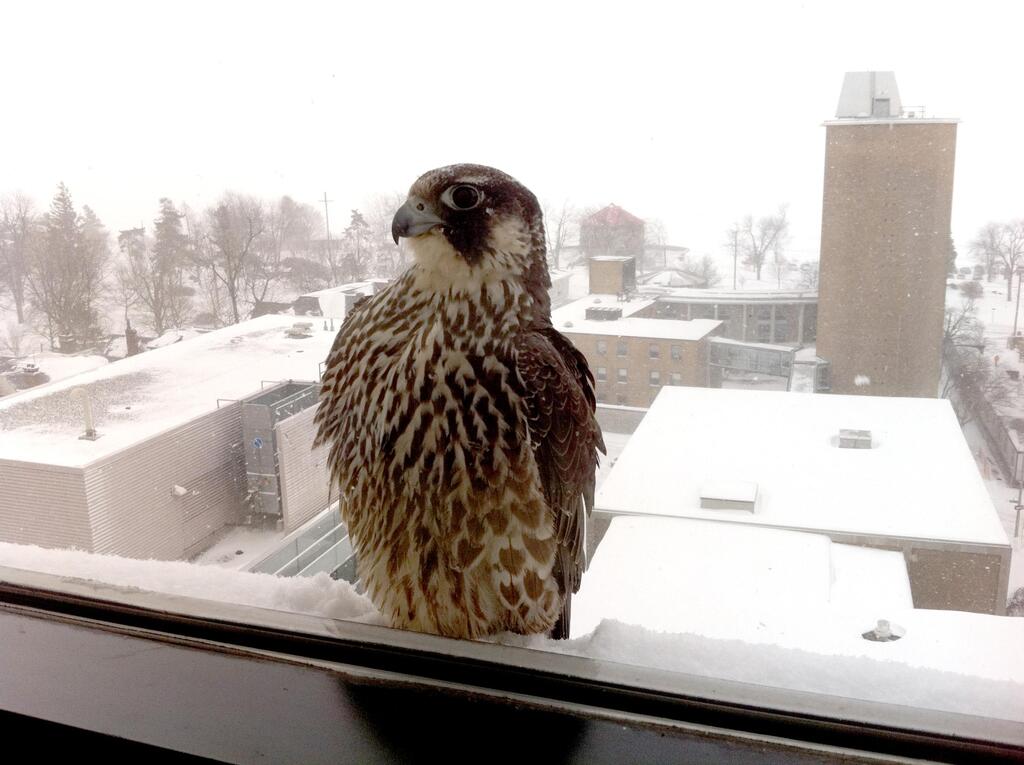
Recently a posting was made to The Weather Channel ( www.theweathernetwork.com ) with the photo included taken by Richard Huang on Feb 2,2011 in Kingston, Ontario Canada. The Peregrine Falcon was  perched on Botterell Hall, at Queen’s University, during a recent snow storm.


Peregrine Visits Queens

!!! Fallon,Nevada 4 Golden Eagles Shot

January 30, 2011 - International, National and Local News

Frank Butson Reports:

Fish and Wildlife Investigating Deaths of Golden Eagles Near Fallon
The U.S. Fish and Wildlife Service is investigating the deaths of four golden eagles found in the area between Fallon and Lahontan Reservoir. A preliminary investigation indicated the eagles had been shot.
Shooting an eagle is a violation of the Bald and Golden Eagle Protection Act as well as the Migratory Bird Treaty Act. Penalties for violating the Bald and Golden Eagle Protection Act can include up to two years confinement and $250,000 fine. Penalties for violating the Migratory Bird Treaty Act include up to six months confinement and $15,000 fine per bird.
     Golden eagles are frequent visitors to the Carson and Lahontan valleys this time of year, and can often be seen near rivers, ponds, lakes and agricultural fields. Their preferred prey is small mammals like rabbits, ground squirrels, mice and sometimes small birds. Golden eagles are most often seen scavenging animal carcasses, especially during winter months when their normal prey is not readily available.

Anyone with information about the eagle deaths should contact the U.S. Fish and Wildlife Service Office of Law Enforcement at 775-861-6360.

UK:Barn Owls Perish From Winter Weather

January 24, 2011 - International, National and Local News

Frank Butson Reports:

From The BBC Humberside

Wildlife artist’s crusade to save Wolds barn owls

Nest box with owl inside

Robert Fuller and his wife, Victoria, setup a conservation group to protect owl numbers

The enchanting flight of the barn owl was once a common sight in East Yorkshire. But now their frequency could be a thing of the past if the extreme weather returns, warns a wildlife artist.

Robert Fuller does more than just paint birds.

A barn owl conservationist, the artist set up the Wolds Barn Owl Group in 2006 to conserve birds and installed 137 nest boxes on farmland across East and North Yorkshire.

However, the heavy snowfall during November and December last year, which was the worst for over 100 years, has caused their numbers to drop.

Mr Fuller said the owls had struggled to survive without their natural food supply and he had found more than 20 dead birds on the Yorkshire Wolds.

Dead barn owls

Twenty four barn owls were found dead by the artist

“After this terrible weather we’ve had, we could’ve lost up to 90% of our barn owls on the Wolds and I’m certainly not going to let the last few die out.

“So I’m going to help them through; build their body weight up because if we get another really bad spell of weather, that’s going to really affect them.”

Barn owls weigh an average of just 12oz and can survive a maximum of two weeks without food.

They hunt grasslands to feed on mice, voles or shrews. However, heavy snowfall makes it difficult for owls to find food, leaving them to starve.

“The snow lasted for so long that birds continue to hunt but they just became ever weaker and ever more emaciated and just couldn’t sustain themselves, so it’s impacting on their population really heavily,” explained Ian Kendall from the RSPB.

“Normally when the snow retreats you tend to see barn owls then hunting successfully again over the grassland and that’s just not happening. We’re not seeing barn owls now back at sites where you’d expect to see them.”

Robert Fuller

Mr Fuller said his conservation project had been a success until this winter

As part of his voluntary conservation work, the artist regularly attends to some of the nest boxes, especially those situated in the five-mile radius of his home in Thixendale, filling them with dead mice and day-old chicks, which are a by-product from the poultry industry.

“Mice are actually more nutritious for them. But these [day-old chicks] are the next best thing for them to get through this bad spell of weather we’ve had. I put eight of them in the box and that’ll certainly keep them going for the next three or four days,” explained Mr Fuller.

“We don’t want to stop these birds from hunting but with it being so few of them left, I feel it’s very important to get the remaining ones through the winter because we need some breeding nucleus for the spring.”

The heavy snowfall during the cold snap has made it difficult for Mr Fuller to reach the nest boxes and of the 30 sites he visited, has only seen four owls alive.

“It’s worse than anyone can imagine really, I’ve got 24 dead barn owls and have only found four live owls… it’s basically crisis point that I’ve got to not let these remaining owls die.”

!!! Red-shouldered comes to visit. Who is watching who??

January 10, 2011 - International, National and Local News

CPF Postmaster Reports:

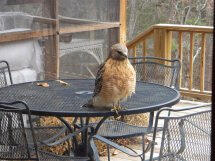
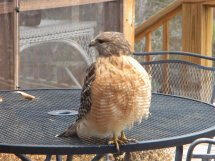
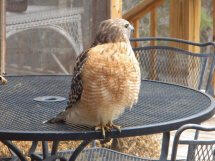
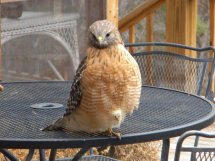
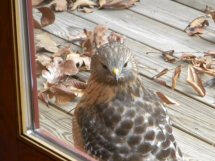
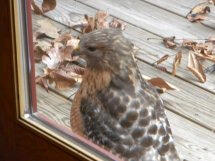
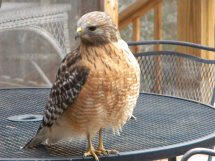
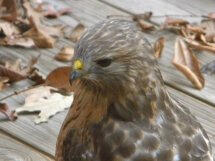
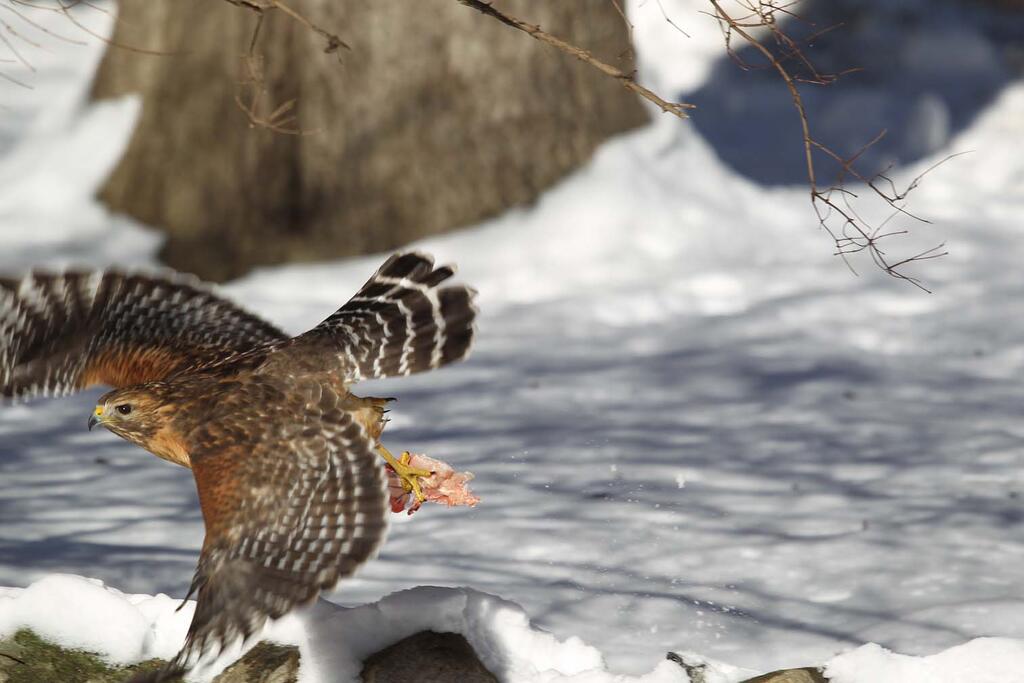
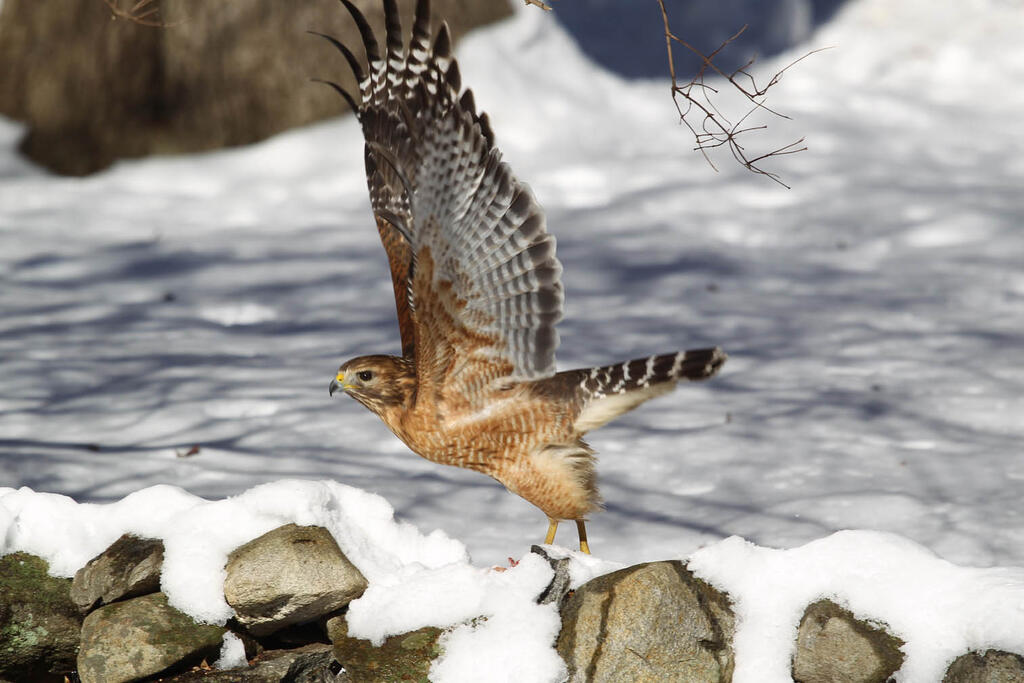
Big thank you to Ann Willis for sending in her photos of a red-shouldered hawk that came to visit her in early January 2011. After we help identify her special visitor, we asked for her permission to post some of her shots, as we don’t get to see allot of Red-shouldered hawks in our neck of the woods and rarely do we ever get such great close up shots!! We will also be posting them in the Raptor ID sections of the CPF web site so others can benefit from these great views of the red-shouldered hawk. The photos were taken Jan. 10, 2011. The hawk has been on my front porch and then on my deck yesterday. I believe that he was seeing his reflection in my sliding doors. He tried a couple of times to fly into the glass, flew off, then returned and sat first on the table, then on the deck right next to the door looking into the house. He stayed around most of the morning. I am the photographer and you have my permission to post the photos. I will include a bunch more.
Sent from: Ann Willis
Primrose Creek
Heber Springs, AR
USA


!!! KINGSTON:Peregrine With Potentially Dangerous Gear

January 23, 2011 - All Reports

Frank Butson Reports:

Recently on a birding trip to Amherst Island near Kingston,Ontario, Canada Ann Brokelman a CPF volunteer,photographed a Peregrine Falcon flying past her very quickly. She got a few quick shots of the juvenile plummaged Peregrine as it flew by,which shows some kind of entanglement. The location was west of the ferry docks on Amherst Island.

   People in the area should be on the watch for this bird.

Mark Nash CPF Co-VP and C0-founder writes:This is something that the bird has got caught up in, as this is not any telemetry or any typical falconry equipment.  While it could be a leash of sorts, it is NOT in any proper position that would benefit the bird at all. This is kind of tragic, if this stays on this bird, as there is a terrible,potential risk to the bird’s well being with such an attachment.  Fingers crossed that what ever it is, comes off!!

An email will be sent to the Kingston Field Naturalists and other avid birders in the Kingston area.  CPF volunteer Frank Butson will be in the field at Amherst Island next week and will keep eyes open for this bird.

!!! Bye Bye Blackbird: USDA acknowledges a hand in one mass bird death

- All Reports

Frank Butson Reports:

From The Christian Science Monitor:

One in a series of mysterious mass bird deaths in the past month was the product of a USDA avicide program, which began as operation Bye Bye Blackbird in the 1960s.

A worker with US Environmental Services, a private contractor, picks up a dead bird in Beebe, Ark. on Jan. 1. The USDA said it killed hundreds of starlings in South Dakota this week.Warren Watkins/The Daily Citizen/AP/File

By Patrik Jonsson, Staff writer / January 20, 2011

Atlanta

It’s not the “aflockalyptic” fallout from a secret US weapon lab as some have theorized. But the government acknowledged Thursday that it had a hand in one of a string of mysterious mass bird deaths that have spooked residents in Arkansas, Louisiana, Alabama, South Dakota, and Kentucky in the last month.

The United States Department of Agriculture (USDA) took responsibility for hundreds of dead starlings that were found on the ground and frozen in trees in a Yankton, S.D., park on Monday.

The USDA’s Wildlife Services Program, which contracts with farmers for bird control, said it used an avicide poison called DRC-1339 to cull a roost of 5,000 birds that were defecating on a farmer’s cattle feed across the state line in Nebraska. But officials said the agency had nothing to do with large and dense recent bird kills in Arkansas and Louisiana.

Nevertheless, the USDA’s role in the South Dakota bird deaths puts a focus on a little-known government bird-control program that began in the 1960s under the name of Bye Bye Blackbird, which eventually became part of the USDA and was housed in the late ’60s at a NASA facility. In 2009, USDA agents euthanized more than 4 million red-winged blackbirds, starlings, cowbirds, and grackles, primarily using pesticides that the government says are not harmful to pets or humans.

In addition to the USDA program, a so-called depredation order from the US Fish and Wildlife Service allows blackbirds, grackles, and starlings to be killed by anyone who says they pose health risks or cause economic damage. Though a permit is needed in some instances, the order is largely intended to cut through red tape for farmers, who often employ private contractors to kill the birds and do not need to report their bird culls to any authority. “Every winter, there’s massive and purposeful kills of these blackbirds,” says Greg Butcher, the bird conservation director at the National Audubon Society. “These guys are professionals, and they don’t want to advertise their work. They like to work fast, efficiently, and out of sight.”

Bird kills turning too zealous?

The depredation order, however, is under review for its impact on the rare rusty blackbird, which roosts with more common species. Ornithologists also suspect that the mass killings may be a factor in declining populations of those species in the US.

While the USDA keeps tabs on the number of birds the program euthanizes, the total death toll isn’t known because private contractors operating under the depredation order aren’t required to keep count in the case of blackbirds, cowbirds, grackles, and starlings.”My biggest concern is we don’t know how many birds are being killed, and we don’t have a sense of how at risk the rusty blackbird is because of depredation events in their range,” says Mr. Butcher.Yankton animal control officer Lisa Brasel told KTIV-TV that she first believed a cold snap had killed some 200 European starlings that were found dead in Riverside Park, reminding some residents of the final scenes of Alfred Hitchcock’s thriller, “The Birds.”

But then she said she received a call from a USDA official who said the agency had poisoned a roost of starlings 10 miles south of Yankton. Usually such poisonings result in flocks falling directly out of their tree roosts. But in this case, the birds traveled a fair distance before falling. “They were surprised they came to Yankton like they did and died in our park,” said Brasel, according to KTIV-TV.
How birds plague farmers Carol Bannerman, a Wildlife Services spokeswoman, said such kills are carried out at the request of farmers who can prove the birds are a nuisance. The farmers also help pay the cost, according to the agency.  One example of nuisance birds are European starlings, a non-native species, at US dairies, where a flock of 5,000 can eat 200 pounds of feed a day while soiling equipment and dairy cows.”It’s not that we have anything against starlings, but our charge is to help protect agriculture … and protect property and human health or safety,” she says. “And the fact is, in a lot of rural settings, people say, ‘It’s just birds, what’s the problem?’ “

Ms. Bannerman added, however, that the agency takes care to notify local public-health and law-enforcement agencies before a scheduled kill, and noted “what went on in Louisiana and Arkansas, that was totally outside of what we’re doing. We’re quite concerned that people not connect those.”

Two mass bird deaths in north Alabama this week are being investigated, with specimens being tested for toxicity. Two other mass bird deaths in Gilbertville and Murray, Ky., earlier this month were not linked to poison, but could have been caused by unseasonably cold weather. The most widely reported recent mass bird deaths – in Louisiana and Arkansas – have been tied to birds en masse flying into buildings and power lines.

Rogue fireworks in Arkansas

In Arkansas, state ornithologist Karen Rowe has reviewed ground radar records that show a 20,000-plus bird roost taking flight at approximately 10:15 p.m. on New Year’s Eve, 15 minutes after a series of large booms shook the windows of houses in a nearby subdivision.

This has caused state wildlife officials to pin the blame on a resident who may have gotten a hold of professional-grade fireworks. The dead birds were likely animals that were trying to land in the dark and hit some kind of object after being drawn to toward the artificial light of the neighborhood.

“So far, no one has confessed to letting off the fireworks, but the question remains if anyone would admit to it,” says Ms. Rowe. They needn’t fear retribution. Despite the number of birds that died, no laws were broken.

Some 5 billion birds die every year across the US, most largely unnoticed. Mass deaths are not uncommon. The US Geological Service’s website listed about 90 mass deaths of birds and other wildlife in the last six months of 2010.

“Whether people are noticing it more and pointing it out more this year than in the past, is something that I’d be thinking about,” says Bannerman at the USDA.

CPF’s NOTE: I also found this:More likely, says Ed Clark, president of the Wildlife Center of Virginia, is that the Arkansas birds were targeted by a farmer fed up with them feeding on his cattle grain. No licenses are needed to kill blackbirds and starlings, and poisoning is a common method of controlling large, noisy flocks.“This was a deliberate act of avicide, legal or illegal,” writes Mr. Clark in a comment on the Huffington Post. (Surface tests on the birds turned up no evidence of poison, but it’s not yet clear whether the birds ate something poisonous.)

CPF’s concern is that this type of mass poisoning has the possibility for secondary host poisoning,especially to raptors that feed on smaller birds. Falcons,hawks,owls and a host of other avian and land based predators would be in danger.

!!! Quest photographed in Kingston Ontario - Jan 4th 2011

January 04, 2011 - International, National and Local News

CPF Postmaster Reports:

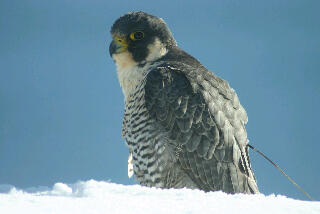
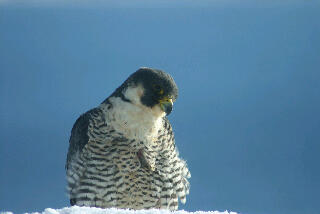
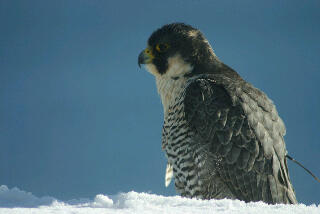
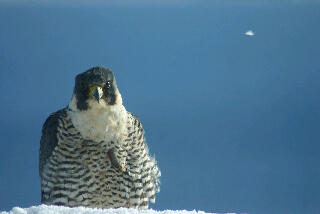
A big thank you to Rachel from Kingston Ontario for sending in some of her photographs of a peregrine that dropped in for a visit long enough to be photographed. rachel writes: These pictures were taken January 4, 2011 around 11:00 am. The peregrine perched on our balcony railing in the Kingston Harbour for over one hour. I took these pics through the window with a telephoto lens. He came again yesterday (Sunday the 16th) and stayed for about 15 minutes.


Photos by Rachel McRae Quest - Jan 4th 2011 Quest Jan 4th - 2011 Quest Jan 4th - 2011

Nice Red-shouldered shots from Ivoryton CT USA

January 18, 2011 - International, National and Local News

CPF Postmaster Reports:

Photos taken in Ivoryton CT by Daniel Mesdeiros with a Canon 1 D mark 4 Lens was a Sigma 500mm 4.5 photos while at a friends house in the morning of January 18th / 2011


Red-shouldered shots by Dan Mesdeiros

Peregrine Falcon Released in 1994 Shot in Indiana

January 04, 2011 - International, National and Local News

Frank Butson Reports:
One of the 15 peregrine falcons released in Downtown Evansville in 1994 amid public fanfare was found injured by a gunshot on Dec. 22 and died on New Year’s Eve, according to the Indiana Department of Natural Resources.
The agency is seeking information on the bird’s injuries. Phoenix, a female, was found injured in Floyd County near the Interstate 64 bridge in New Albany. Phoenix was taken to the Hardy Lake Raptor Rehabilitation Center that night, but she died on Dec. 31.
It was the Indiana’s Department of Natural Resource’s first contact with the bird since 1995, though Phoenix and her mate, Screech, had last been seen in Evansville in 1997. The birds were released off the roof of the six-story Centrum Building in the summer of 1994. Urban areas with tall buildings mimic the birds’ natural habitats — open river bluffs and canyons.
According to a news release from the agency, Phoenix may have been nesting in the New Albany/Louisville area, where pairs breed on tall buildings and under bridges.
“Most peregrine falcons are banded as nestlings and later identification can be made if individuals can be approached,” the release stated.
John Castrale, a nongame bird biologist for the Indiana Department of Natural Resources, said Phoenix was relatively old for her species.
None of the 15 released remain in the Evansville area, but Castrale said that is normal.
“They travel widely and they usually don’t stick to the site where they were released,” he said.
Male peregrine falcons have been known to travel up to 100 miles from their release sites and females as much as 200 miles, according to Castrale.
“Some have been known to go as far as 1,000 miles away,” he said.
In 2010, at least 38 adult falcons were observed nesting in Indiana, he said, including 11 sites where eggs were laid.
The location of only one other of the 15 peregrine falcons released in Evansville is currently known. Castrale said Freedom, a female, has been nesting in downtown Fort Wayne for several years.
“I’m hopeful one of these days we will see them in Downtown Evansville again,” he said.
A nesting box for peregrine falcons remains ready for them there.
Another, a male named River Ace, was confirmed to be nesting at a power plant in southwest Ohio in 2002.
The crow-sized peregrine falcons are easily confused with their smaller cousin, the American kestrel or sparrow hawk, which s also often found perched or nesting in the crevices of church steeples or tree cavities.
A distinguishing characteristic of a peregrine falcon is their long pointed wings. Adult birds are slate gray with a dark helmet and sideburns, a white throat, and finely barred breast and belly.
Peregrine falcons were removed from the federal endangered species list in 1999 but remain a state endangered species in Indiana.
“They never were really common,” Castrale said.
Up to 200 nesting pairs are known in the Midwest, he said.
Anyone with information about the shooting should call (800) 847-4367

CourierPress