April 03, 2011 - Brampton - Courthouse
Frank Butson Reports:
While activity seems to have slowed at this site,local folks are keeping their eyes peeled for a pair of Peregrine Falcons,which have been in the area for the last 2 seasons. This would be the first known nest in the Brampton area.
Please excuse the delay in posting this report,our Sportsmans Show participation and other personal issues caused the delay.
Terry Osborne a self-described “obsessed birder living in Dundas, Ontario and have been so obsessed since the 80’s.” Posted about a sighting at the Brampton courthouse. I was able to contact Terry and he reported:
A bit of history, in early February I thought I saw a peregrine leaving the court house building. I saw it flying away and while I wasn’t 100% sure of its ID, I immediately suspected a peregrine. I even pointed the bird out to a colleague. This past Wednesday at around the supper hour I saw 2 peregrines flying in from the northwest (I was inside the building looking out) and they appeared to land on the northwest corner of the building. Then on Saturday I saw the birds again as noted above. Again this morning I saw the male, what I at least think is the male, perched on the same section of roof as show in the attached photos. The second bird I only heard coming from a different part of the roof.
This building has an ample supply of rock pigeons. While only being a 7 storey building it has a great vista of the surrounding area and there appears to be an ample supply of prey within the area. I have been contacted by at least another pair of Brampton birders who have told me they will try to monitor this site as will I as I work there. I also hope that this pair decides to set up housekeeping on this building and provide the first nesting record of peregrine falcons in the Brampton area.
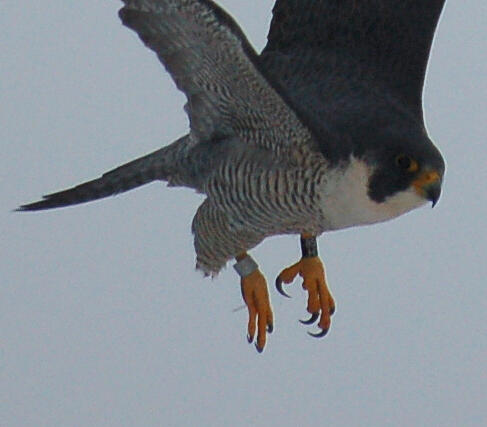
Terry sent along a few photos. While one is alittle blurry from cropping,it shows there is no band on the leg of the Peregrine,believed to be the male.
Since this sighting Terry has said sightings have slowed,but a friend of Terry’s named Don,reported on: saw a pair of peregrines at the Rose Theatre on Saturday, March 18.
Independantly,a gentleman approached me at The Toronto Sportsmans Show and told me of a pair of Peregrine Falcons that were at the Brampton courthouse last season.
We look forward to hearing from Terry and his friends about any future developments.
Posted on April 3, 2011 10:37 am
March 23, 2011 - International, National and Local News
Frank Butson Reports:
From The Hamilton Spectator
John Burman
Even for eagles, it’s all about location

Bald eagles may be born here A pair of eagles are nesting high in a white pine on the Royal Botanical Gardens lands on the northern edge of Cootes Paradise. If there are eggs in the nest, they may well hatch mid-April.
Ron Albertson/The Hamilton Spectator
If all goes well, Hamilton could soon be home to the first young bald eagles hatched around this side of Lake Ontario in more than 50 years.
And it all comes down to location.
A pair of eagles are nesting high in a white pine on the Royal Botanical Gardens lands on the northern edge of Cootes Paradise. If there are eggs in the nest, they may well hatch mid-April.
At the moment, all things point to the return of the first Lake Ontario-born eagles in Canada in the decades since pesticides and environment changes drove them into near extinction. There were only four active nests, or about 15 birds, by the early 1980s.
Environment Canada says no bald eagles have nested on the north shore of Lake Ontario since the late 1950s.
Elimination of DDT, which damaged the shells of eagle eggs well into the 1970s, and vast improvements to fish habitat in Cootes Paradise have played a hand in bringing the birds back to this area.
“This milestone is testament to restoration efforts of Project Paradise,” Tys Theysmeyer, RBG’s head of natural lands, said in a statement. “As we bring Cootes Paradise back to the condition it was before the 20th century, species that once called this area their home will continue to return.”
The eagles were first spotted in the wilderness area west of Highway 403 in 2009, when the male was too immature to reproduce, said Tys Theijsmeijer, head of natural lands for Burlington’s Royal Botanical Gardens.
“We’ve just been waiting for the immature one to graduate to adulthood,” he said. “In the interim they built a nest.”
“We’re pretty sure that if they were going to lay eggs it was in the past two weeks,” he explained. “So we’re looking at mid to late April to see little heads poking up in the nest.”A hundred years ago, bald eagles were a common sight along Lake Ontario. But toxic pesticides slowly killed off most of the population.
“The water became polluted with DDT used in agriculture that washed off the land into the lake,” Theijsmeijer said. “The poison got into the fish, the birds ate the fish and it caused the shells of the birds to be thin and shatter.
“So we just ran out of bald eagles.”
DDT was banned in the United States in 1972 and in Canada in 1989, although its use had been restricted for more than a decade before that.
The eagles have very specific requirements. They need at least 100 hectares of forest to rest and roost and it has to be adjacent to about 50 hectares of wetlands to allow them to catch fish.
The birds have forest and they have fishing in Cootes Paradise due to the steady improvement of the wetland since the creation of the fishway in 1997, which bars invasive carp and has fostered natural regeneration.
RBG has been trying to attract a nesting pair for some time. There are 31 active nests on the great lakes and another 39 north of the 49th parallel but, until now they hope, not a single nest on the Canadian side of Lake Ontario.
The gardens staff say several bald eagles have stayed in Cootes over the winter the past few years and finally a pair stayed over a summer.
Gardens staff built a platform high in a 33-metre white pine in March 2009 with the help of a Hamilton tree maintenance company, hoping a pair would make it their home.
Instead, a pair picked a pine two trees over and built a nest. The pair have built nests on the north and south sides of Cootes since. They have now reached maturity, returned to the north shore site and settled in, hopefully to raise a family.
With files from TorStar News Services
jburman@thespec.com
905-526-2469
How to view the eagles
The RBG has been careful to provide directions to enable those interested to get to the area of the nest without disturbing the birds.
And, they say, it would be a good idea to bring binoculars.
The closest view is from the Marshwalk Observation Platform:
The nest is located on the north shore of Cootes Paradise, about 400 metres directly west of the Marshwalk platform, with the nest set in a lone pine on a ridge in the middle of the Hopkins Wood special protection area.
To get to the platform, start at the RBG Arboretum at 10 Old Guelph Rd. and head west, walking down the Captain Cootes, Bull’s Point and Marshwalk trails to the observation platform. Its about a 1.5-kilometre walk from the arboretum parking area.
The view from Princess Point, at 335 Longwood Rd. in Hamilton, is from a spot near the fishway at the Desjardins Canal and the nest is clearly visible, but it is at a distance of two kilometres.
Posted on March 23, 2011 2:14 pm
March 10, 2011 - International, National and Local News
Frank Butson Reports:
From THE TORONTO STAR
Curtis Rush Staff Reporter
For years, a volunteer group has been trying to get the message out about the migratory birds who die by slamming into the reflective glass of Toronto office buildings each year.
On Wednesday, they took this message to the Royal Ontario Museum, where they laid out close to 2,000 dead migratory birds on a canvas for the public to see.
And next month, they hope the message is further driven home in a Scarborough courtroom.
On April 7, the managers of The Consilium Place office towers in Scarborough will have to answer to charges under the Environmental Protection Act and the Ontario Society for the Prevention of Cruelty to Animals Act.
“This could be a precedent-setting case and a conviction could send a message to other businesses,” said Albert Koehl, a lawyer for Ecojustice, which has brought the private charges.
The trial is expected to last six days and fines could be substantial, Koehl said. In addition, a provision could be made to order changes to the glass structure thought to be a prime killer of migratory birds.
The towers, near Highway 401 and McCowan Rd., are covered in mirrored glass and are as high as 17 storeys.
In 2008-2009, more than 800 birds were recovered from the lawns around the complex.
Michael Mesure, 47, executive director of the Fatal Light Awareness Program, said he’s frustrated that existing buildings in Toronto are not being mandated to make design changes to protect birds.
Under the city’s bird-friendly guidelines, new buildings must meet certain performance standards that involve muting reflections and treating glass with density patterns.
The executive director of FLAP said simple adjustments such as visual markings on glass windows can help give birds an alternative point of focus.
At the ROM on Wednesday, spectators watched as volunteers laid down the carcasses of migratory birds — everything from birds of prey to small song birds.
“It breaks my heart,” said Kathy Nosich, who works in the biodiversity program for Ontario Power Generation.
She said the display of birds who met their fate by colliding with glass structures brings home the message.
“Nothing tells this story better,” she said.
Mesure, who began FLAP in 1993, says many people remain “in denial” about the problem of dead birds because they don’t see carcasses lying on the streets and don’t realize the ecological benefits of making sure they survive.
“They eat thousands of insects,” he said.
Staff volunteers like Brian Armstrong, who sold his legal practice several years ago, begin patrols throughout the financial district at 4 a.m., collecting injured and dead birds.
The injured birds are taken to the Toronto Wildlife Centre if the gulls haven’t swooped down and taken them away first.
The migratory bird season begins in a few weeks and runs to June.
Posted on March 10, 2011 1:58 pm
March 10, 2011 - International, National and Local News
Frank Butson Reports:
The Canadian Peregrine Foundation invites everyone to come to the Toronto Sportsmans Show and visit our booth. Meet our feathered educators and volunteers. March 16th-20th. Learn about our raptors,programs,conservation efforts and ask questions. Each year CPF is asked to participate in the Toronto Sportsmans Show and our booth is a show stopper. The show-goers love to stop by to see our live birds of prey exhibit.
Meet Kyla The American Kestrel 
Alexandra The Great Horned Owl

Solo The Bald Eagle

Oscar The Peregrine Falcon

And the rest of the Canadian Peregrine Foundation feathered education team at the Metro Toronto Convention Centre. Admission prices,directions,hours and other information about the show can be found here http://www.torontosportshow.ca/visitors/ Thats March 16-20th,2011. We hope to see you there.
Posted on March 10, 2011 7:02 am
February 21, 2011 - International, National and Local News
CPF Postmaster Reports:
Hello folks at CPF – update on the Saint John peregrines…and, yes, I can confirm the plural.
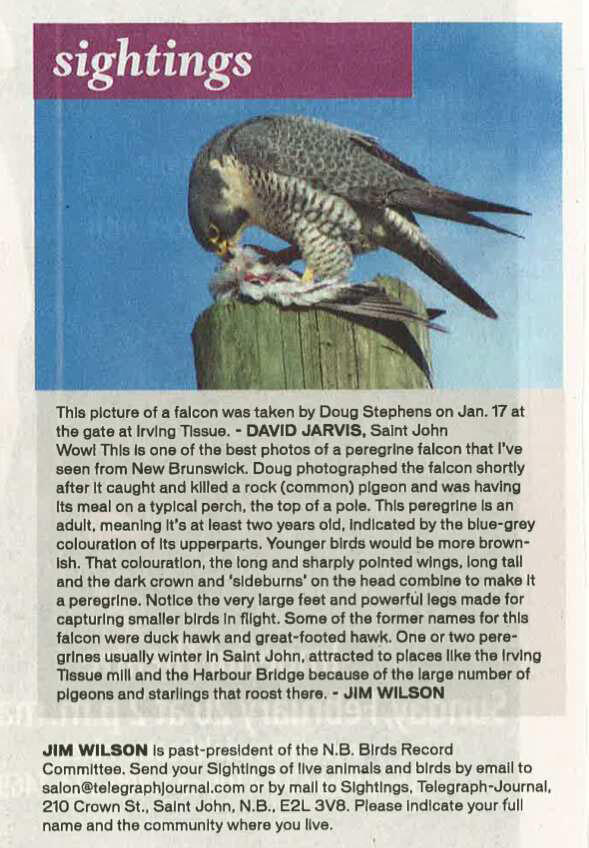
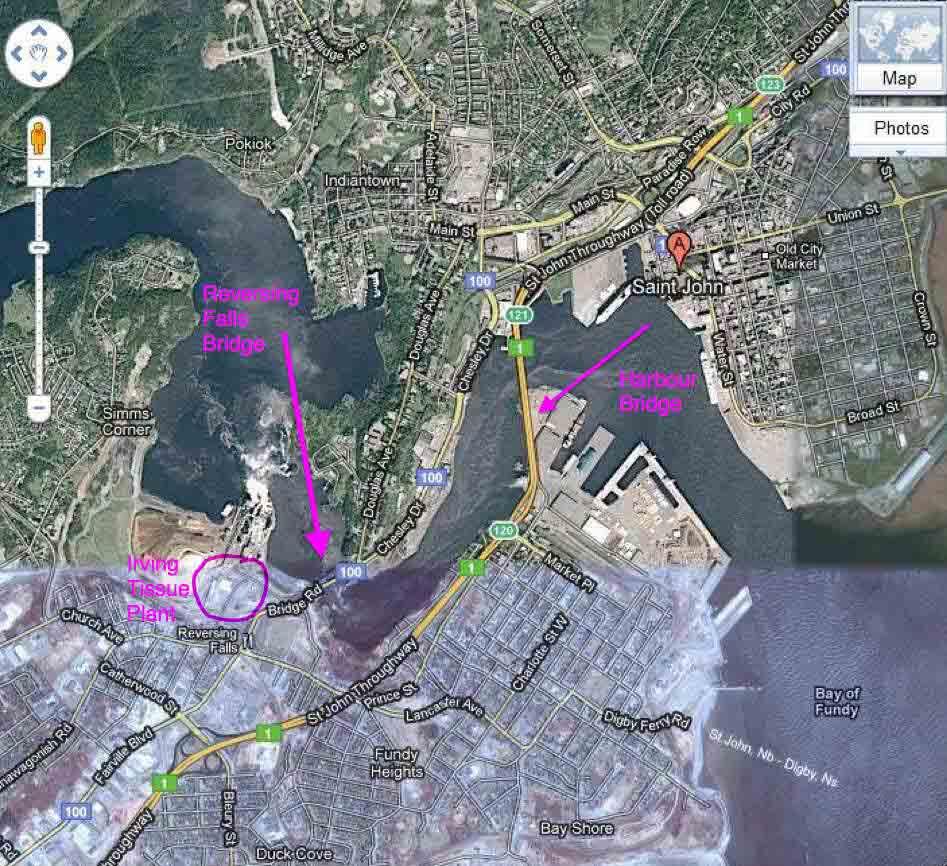
Spotted two peregrines yesterday at 3:12pm over the Reversing Falls Bridge. The bridge crosses the narrowest point of St. John River where it widens out into the harbour and then flows out to the Bay of Fundy. Incidentally, the Irving Tissue Mill is very close to this bridge. The Falls attracts a lot of sea birds: gulls of all sorts and cormorants (summer), there are lots of rock doves and also different species of hawks, the occasional bald eagle and now the peregrines.
As I was approaching the bridge by car, my attention was caught by a lot of gulls swirling about in the air. I pulled over and parked the car and that’s when I saw two peregrines in silhouette from below. One flew down and levelled out and gave me a very good look at him/her - I could clearly see the “sideburns” on the cheeks and the dark grey colouring on his/her back. I didn’t have binoculars or a good camera (Iphone was useless –Apple designers need to correct that deficiency).
I watched them for about 15 minutes - there were two and they were hunting. I watched one bird “stoop” and dive in an attempt to catch a gull. He/she missed the gull by inches. Quite something to see! I didn’t see the Pefa’s close enough together to be able to say for sure they are a male and female pair.
A good digital camera with movie capability is my next step! I will DEFINITELY get photos. I’m hooked.
Gaye Kapkin
Posted on February 23, 2011 12:00 pm
February 11, 2011 - International, National and Local News
CPF Postmaster Reports:
Further conversations and observations from Gaye, and some research on her behalf, we can confirm that there is in fact at least one territorial pair of peregrines holding a territory in St. John New Brunswick. Thanks to Guye, who was able to resource additional information on the subject,
Gaye writes: Feb. 11th 2011
Hello again! Since we emailed, I’ve been on the lookout for our speedy and elusive friends. I haven’t seen any falcons lately, but I’ve chatted with local birders about peregrine sightings and they assure me that we typically do have a few birds which over-winter here in Saint John. Which was exciting news…
Then, on Saturday, I came across this article and photograph in the “Sightings” column in our local newspaper. And there he/she is - what a wonderful photo! I knew you’d be excited to see this photo and the information.
I’ve also added a little graphic to give you an idea of where the sighting was and the bridges that the article references.
I keep looking!
Cheers,
Gaye Kapkin
Hello CPF
I recently we saw a raptor chasing a pigeon in the King Square area of downtown Saint John, NB. I work on the 4th (top) floor of an office building adjacent to King’s Square and I had a great “front-row” seat. I believe the bird was a peregrine – I wasn’t fast enough to get a camera. This sighting was Thursday Jan. 27th.
Yesterday, when walking my dogs in the same general area, I hear an unusual (ie not the usual gull or crow) bird calls. Looking up I saw two birds – one of which was calling. Again – no camera available! But from the silhouette from below, I’m thinking I saw a pair of falcons.
I’m keeping my close at hand. Hopefully, I can verify if these birds are peregrines or not.
Regards,
Gaye Kapkin
Posted on February 15, 2011 11:55 am
February 02, 2011 - International, National and Local News
CPF Postmaster Reports:
Could there be a second pair of peregrines in Windsor Ontario Canada?
After many e-mail over the past few months, and with a huge thank you to Robert for his determination and persistence, it would appear that there could be another pair of territorial peregrines in Windsor Ontario. He has been watching a water tower at Benjamin and Hanna where there has been allot of raptor activity since October of last year. He recently sent us some video that he shot of one of the birds, along with a couple of observation reports.
While we don’t believe that any offspring has been produced at this site, the presence of a territorial pair holding firm at this site, (and if there is an suitable nesting ledge that they like), it is possible that we may see a new peregrine nest site this spring if the pair stay to the spring.
Robert writes: February 2nd / 2011
Hello again! I captured a little bit of video this morning… put on your headphones because the sound of this particular bird will probably better help you identify it if this is a peregrine.
Follow link to video - http://www.youtube.com/watch?v=FJIXsUpcUFY (click the HD 720P link at the bottom right for higher quality video/audio)
Robert.
October 2010 observation:
I don’t know if you’re aware of this but there is a peregrine living underneath the water tower on Benjamin & Hanna.
And if I’m right there might baby falcons up there as well?? I say that because this morning the firefighters were rappel training from the top and the peregrine was getting very very agitated by their presence. It appeared very defensive about its territory.
I know the one has been living there for at least 18 months but it could be longer. I’ll try to capture them on video sometime but they are elusive.
Robert.
Posted on February 14, 2011 1:56 am
February 13, 2011 - International, National and Local News
CPF Postmaster Reports:
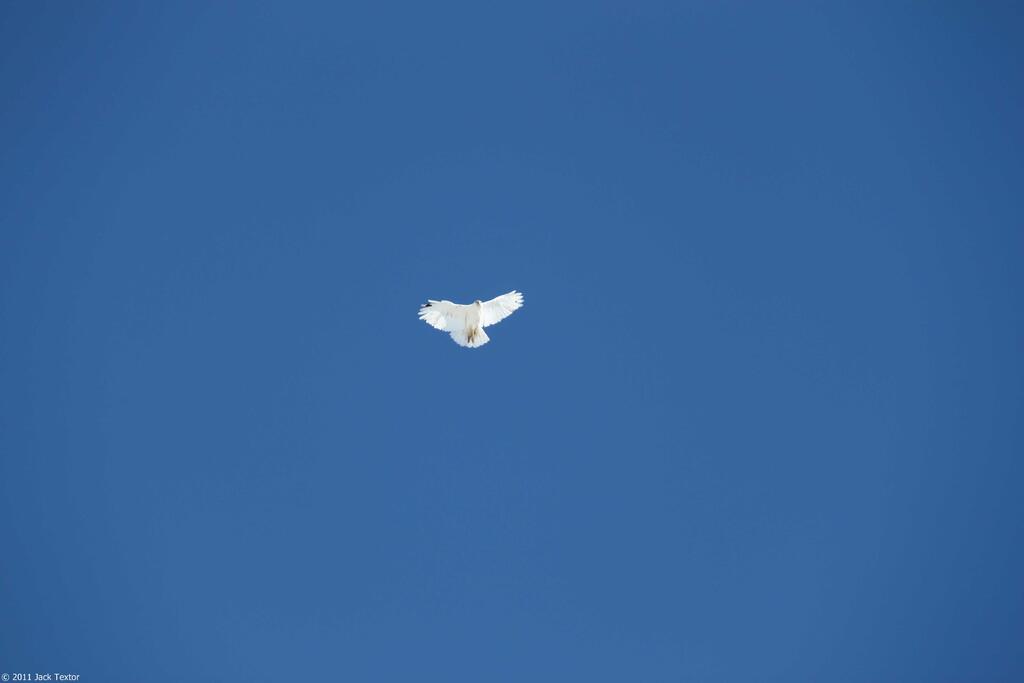
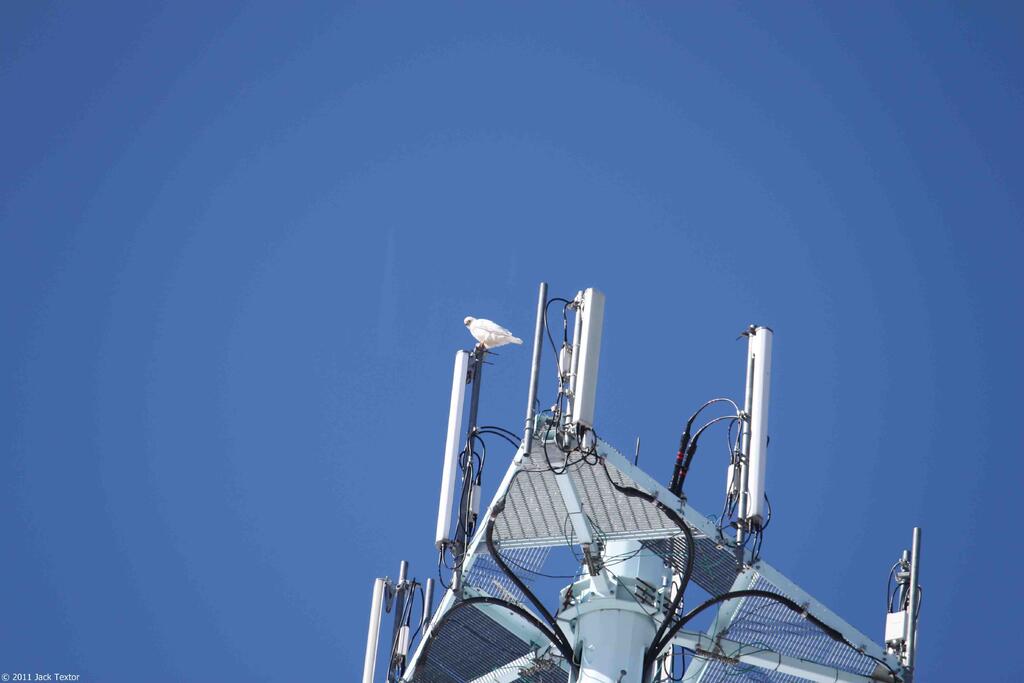
A short update from Jack from Iowa USA with some great photos again of his white Red-tail that seems to be going strong. The two photos that he sent to us were 6 mgs each in size, and after zoooooming up close, you can clearly see two reddesh coloured tail feathers quite clearly. Given the redness of the two tail feathers, our guess is that this Red-tail is likely a male. Photos taken today, February the 13th about 1:00 PM.…Attached full size, good detail when zoomed.
Life is good…
Jack Textor
IA., USA
Posted on February 14, 2011 1:17 am
February 09, 2011 - International, National and Local News
CPF Postmaster Reports:
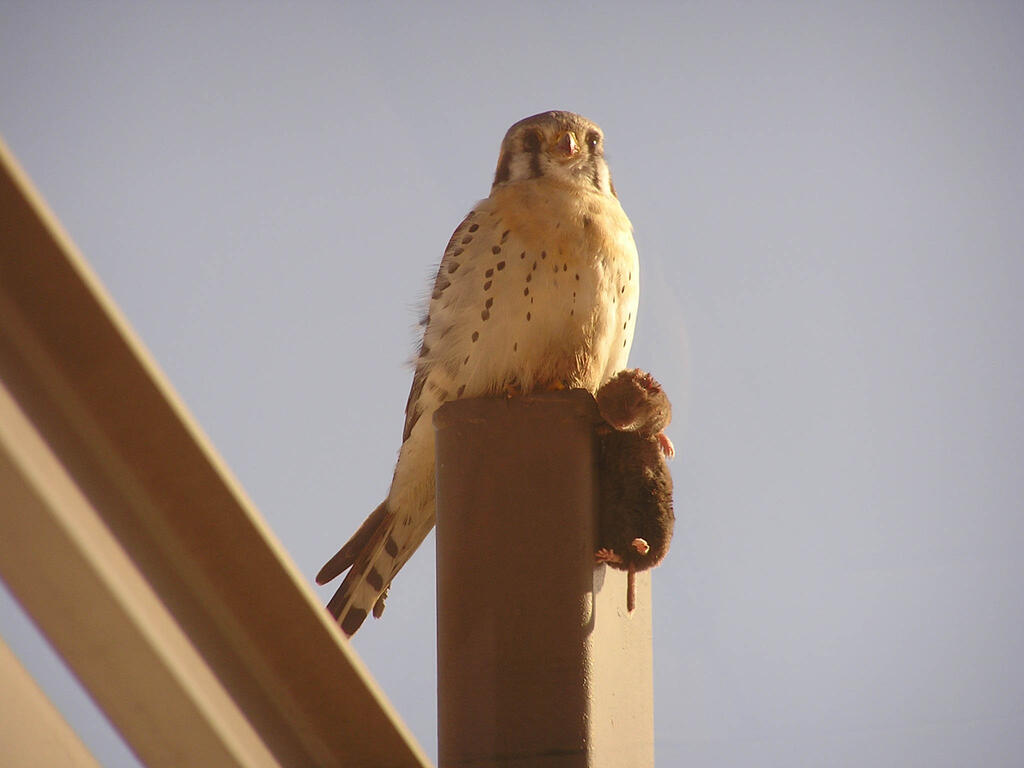
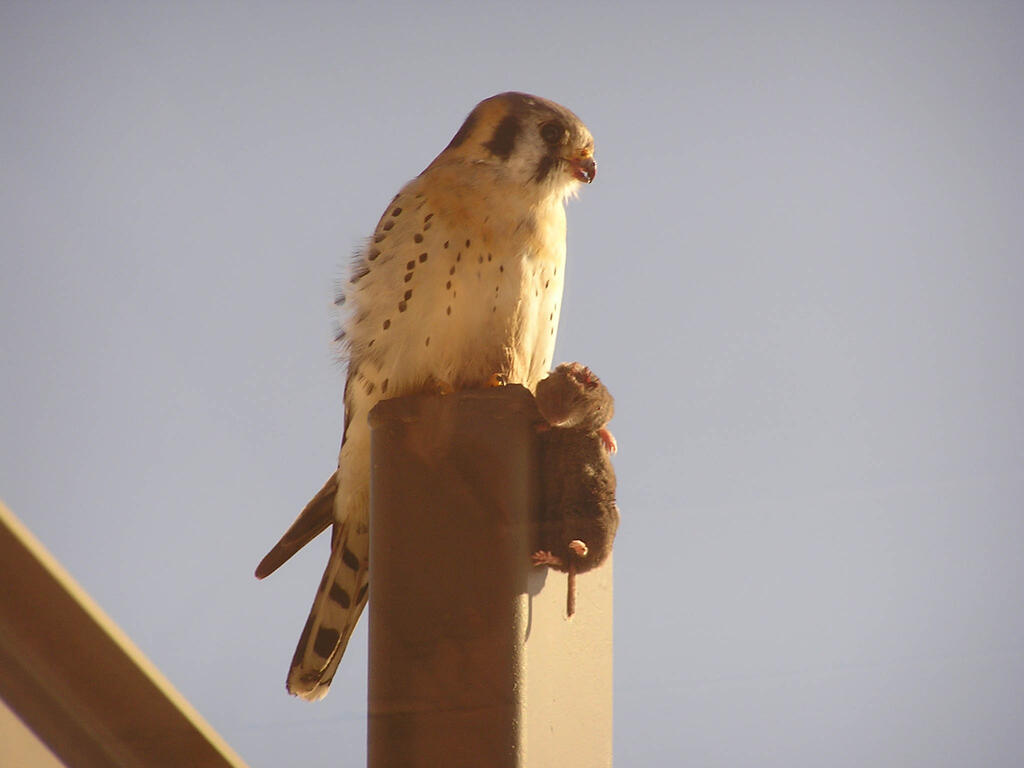
A huge thank you to David from Guelph for sending in these unique photos of an American Kestrel that he had an opportunity to photograph. The Kestrel appears to have a mole or vole, (maybe a mouse) and looking to enjoy a tasty lunch. The photos were taken on February 9 / 2011 at approx. 12:30 pm. They were taken at the Guelph Hydro offices in Guelph Ontario. Photo credit to David Dimma.
Posted on February 11, 2011 1:08 pm
February 02, 2011 - International, National and Local News
CPF Postmaster Reports:
With a huge thank you to Mark Robinson from Port Huron in Mich. USA, we have some interesting news about Tonga, who was produced at the MEC nest site back in 2003. After closer inspection of the great photo he sent into us, the band number was confirmed to be a solid Black band, 85 over H. Our banding records confirm that it is in fact Tonga from the MEC nest site, who was produced in 2003.

Mark writes:
I came across a banded adult Peregrine Falcon on the banks of the St
Clair River, Port Huron, Mi, last weekend.
I’ve attached a cropped image showing the only photograph I managed to
get that shows the bands. It looks to my untrained eye that the band
on the left leg is black and contains the characters 05 (85) above
the character H, with no line between the characters. Is that
sufficient information to identify the bird?
I hope this information might be useful to you and your ongoing
research. If you are able to identify the bird I would love to hear
it’s story and perhaps write a little about it, and the work you do on
my blog
best regards
Mark R.
Posted on February 10, 2011 12:22 pm