affordwatches

!!! Eggs and incubation!!

April 08, 2012 - Scarborough - Yellow Pages

Kathy Smith Reports:

Sunday April 8th - 2012
Great News!!
Today, Jenn and I spent time at yellow pages and we witnessed nest food transfer at 5:30 pm tonight. She is hard on eggs on last years nest site. She is only a day or 2 in because Thurs I saw her bopping around in 1st nest site. Now its just a matter of how many. Start the countdown to hatching!

Kathy :o)

No eggs yet, but it’s gotta be soon!

April 04, 2012 - Scarborough - Yellow Pages

CPF Postmaster Reports:

April 4th-2012

Despite all of the copulation going on between the two resident adults over the past two weeks, a search of the upper ledges this morning didn’t result in us finding any eggs or incubation activity.

To further add to the confusion, six of the eight ledges that surround the upper roof area of the Yellow Pages building all had scrapes on them,, which would suggest that the female is close to laying eggs, but also that the resident adults frustration is also pretty evident. It appears that his mate has not given him any indication as to where “SHE” intends to lay “HER” eggs and raise her family!

Over the past two weeks, Kathy, Bruce and Tracy have all attended the nest site in an effort to get a handle on the birds nesting activities and all have let to their frustration as well. The resident adults have been regularly spotted both “in” and “on” each of the eight ledges.

Today, I was able to confirm that there are bowl scrapes on every one of the eight ledges, and no eggs were located.

Both resident adults were on hand to “over-see and supervise” my visit, with several close stoops at my head to ensure that I got their message.

Sadly, as of today, there are still not egg(s) or incubation activities going on at this time.
PS: It would appear that the two ledges of most interest to the resident adults are on the south - south west ledge and the north - north west ledge.
Stay tuned…………..

Happy Falcons at Yellow Pages

March 30, 2012 - Scarborough - Yellow Pages

Tracy Simpson Reports:

On Friday of last week, I stopped in briefly at the Yellow Pages nest site to check in on Linn and Rueben.  I found the male readily enough as he was yapping up a storm on his perch on the southwest side of the building.  He made several flights around the site only to return to the same perch being just as vocal as before.  It was as if he was trying to tell the world some jubilant news.  Linn made several appearances while I was there and seemed to be just as active and pleased as her mate.  Just before I left, the pair flew up to the very top of the spire on the building to mate.  Based on my observations earlier in the week as well as this day, I would venture a good guess that the first egg has been laid.  We will be checking in again very soon to confirm this as well as confirm which ledge has been definatively chosen.

Linn and Rueben Close to Eggs at Yellow Pages.

March 26, 2012 - Scarborough - Yellow Pages

Tracy Simpson Reports:

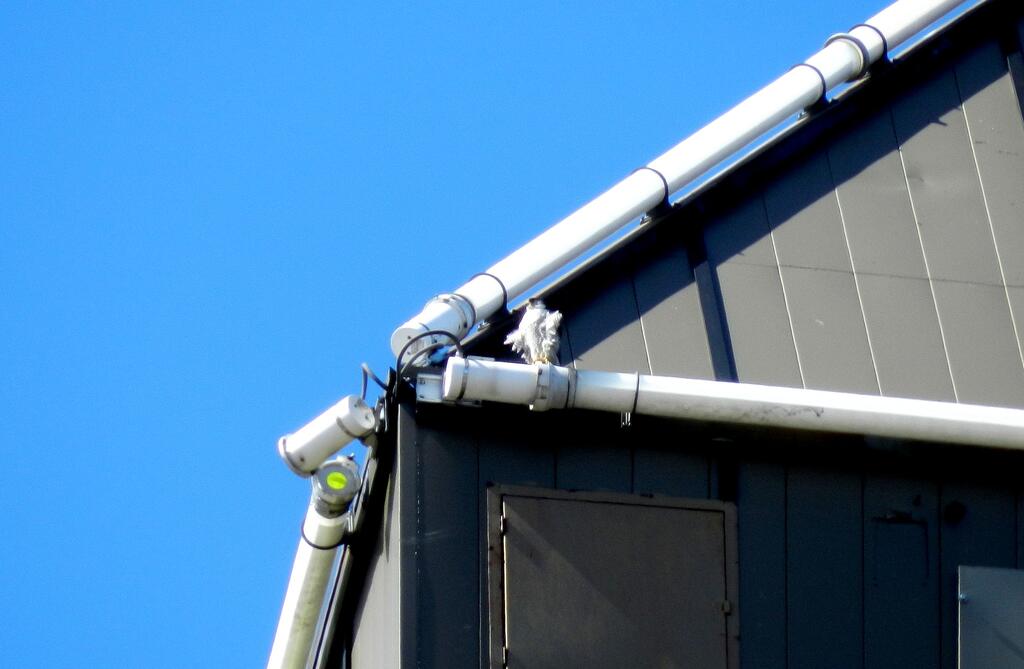
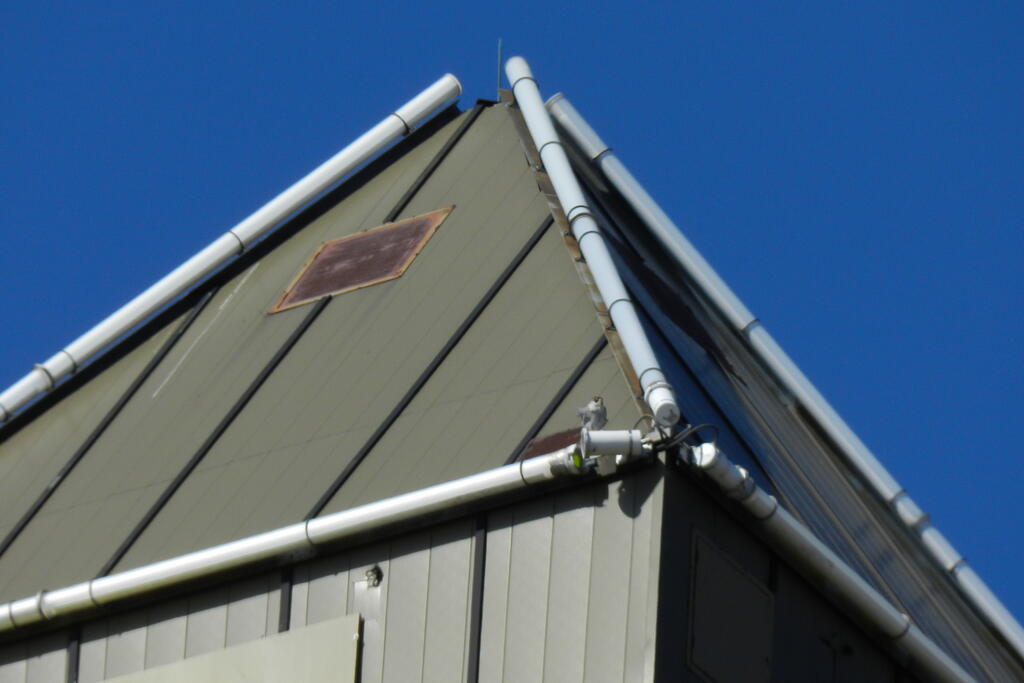
Yesterday when I arrived at the Yellow Pages nest site, I found Linn on the southwest corner of the building whining for Rueben.  She was down in the “shoulder” which the pair use for nesting and at first I couldn’t see Rueben.  I saw something on the pipes of the roof, took a picture but initially dismissed it as a part of the structure.  After looking at the pic, I realized that it was in fact Rueben looking like a windblown puffball.  Indeed the winds were high and Rueben took off to the southwest for another perch.  Linn followed shortly only to return to the same spot as she was before.  A few minutes later, up to the pipes she went where she slept for a good hour.  I went in and spoke to Paul at security who has been exceptionally helpful with observations and support ( thanks Paul! ) and back out I went for a few more observations before leaving.  It is quite clear that they have chosen this particular side ( southwest ) this year in contrast to the northwest site they had chosen last year.  As I was leaving, Linn was on the pipes above her chosen site and Rueben flew in and landed on the nest ledge corner.  I am sure that no eggs are currently in the nest based on the behaviour of the pair but looking at Linn, they are not far off I’m sure!!  In the picture I posted of the building, please note the yellow circle I placed over the spot the pair have chosen.


!!! Mating observed, both resident adults on territory and very active indeed!

March 24, 2012 - Scarborough - Yellow Pages

CPF Postmaster Reports:

Saturday March 24th - 2012
This morning, Bruce reports seeing a lot of activity around the Yellow Pages nest site with both resident adults defending the territory and lighting up the skies with ariel flight displays. During his observations, neither of the resident adults gave him any indication of a nesting spot or indication of any incubation activity, but this is not to suggest that they haven’t laid egg(s).
Given that they were both involved in territorial disputes (and already airborne), they could still have laid one or more eggs by this time and were simply not on the nest during his observation period.

We will be monitoring the situation closely over the next week and hopefully have something more concrete to report.
Stay tuned………

Territorial battles seem to have finished.

March 13, 2012 - Scarborough - Yellow Pages

CPF Postmaster Reports:

March 13th - 2012
Please don’t hesitate to post my update, I hope to contribute a few photos this year as well. As an additional bit of info – the usual spots used for morning meals above the Investors Group sign facing south on 305 Milner Ave (white building west of the Yellow Pages) continues to be in use, and the usual west facing ledges on the Yellow Pages bldg are also still in use. It appears that there has been no change in the usual rituals, so I assume no change in the partnerships….please feel free to post this info as well….
Tom

Territorial battles have begun! Spring is in the air!

March 07, 2012 - Scarborough - Yellow Pages

CPF Postmaster Reports:

Mar. 7th 2012 - Yellow Pages
Good Morning,
Having been an avid watcher of the peregrines at the Yellow pages building over the last few years, I thought I was being treated to another amazing flying display until I realized that there was a third peregrine in the mix. This took place on Mar. 7th at about 7:30am. Two of the peregrines were locked in a swirling, diving aerial joust just above and around the Yellow Pages building, with a third doing tight loops around the top of the building. At the end of it, 2 of the peregrines ended up chasing off the ‘intruder’, however I have no idea who the victors were in this incursion. As the sun was rising and I was west of the building, all that I could make out was the silhouettes of the birds, so I have no identification to pass on. I will try to obtain photos in the near future, and advise accordingly.
Regards,
Tom Hansen

Linn and Rueben Spotted at Yellow Pages

February 19, 2012 - Scarborough - Yellow Pages

Tracy Simpson Reports:

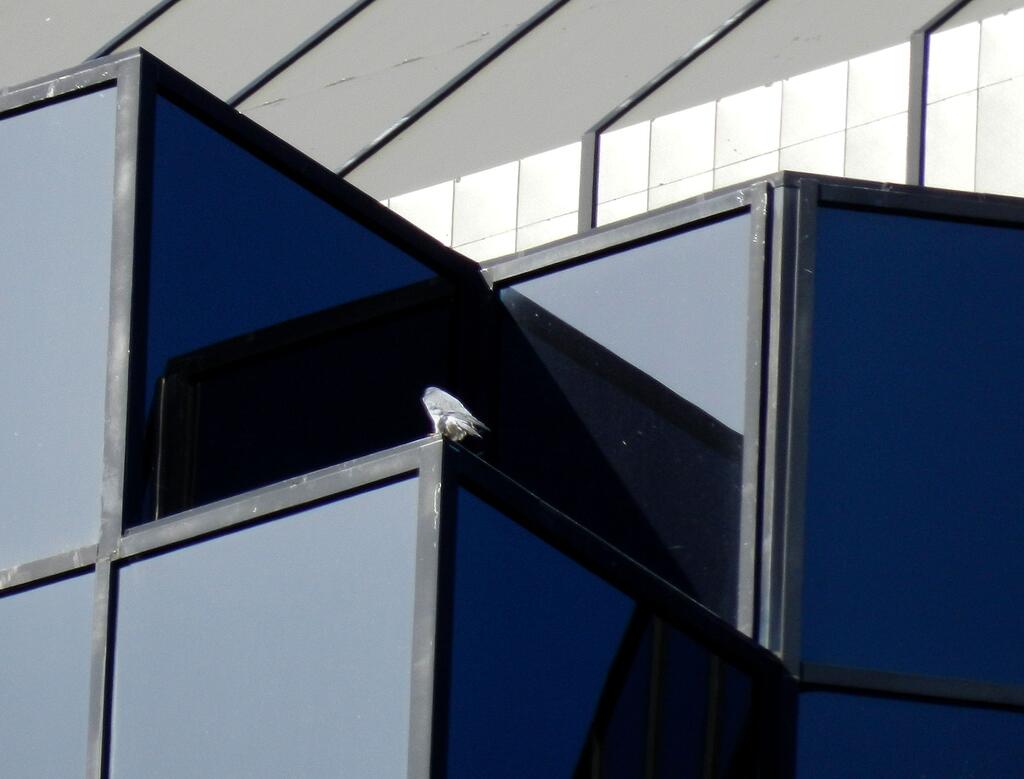
We were fortunate to have the girls from Rochester visit this past weekend and spend some time with our educational birds at the Raptor Centre on Saturday.  On the Sunday, they made the rounds to visit with “their girls” here in Toronto, one of which is Linn.  When they arrived, they found both adults roosting in the afternoon sun on the Yellow Pages building.  It’s great to see the two back in action and we look forward to the 2012 season!!  When you look at the picture, look for the two whitish dots on the upper ledges!!


Site Check at Yellow Pages but No One Home

January 22, 2012 - Scarborough - Yellow Pages

Tracy Simpson Reports:

On our way back to the raptor centre, Frank and I stopped in at the Yellow Pages nest site to check in on Linn and Rueben, the resident pair.  We scanned the building and the known roost spots for the pair but no one was visible.  I have often seen Linn, the female, hunting at the buildings just south of the 401 as the pigeon population there is robust and there are several buildings to use as cover for a surprise attack.  We’ll try again in the coming weeks and hope to catch them at home.

!!! New Pollutants Found In Peregrine Falcon Eggs

November 11, 2011 - Scarborough - Yellow Pages

Frank Butson Reports:

While poking around the internet,I found this article posted at e! Science News. So all will see it,it is being posted on each of our nestsite pages. This is too important to miss.

The original article can be seen here: http://esciencenews.com/articles/2011/04/18/new.pollutants.detected.peregrine.falcon.eggs 

Here is what it says:
New pollutants detected in peregrine falcon eggs
Published: Monday, April 18, 2011 - 09:04 in Earth & Climate

Flame retardants are chemical compounds added to fabrics and plastics to keep them from burning easily, but these can be toxic. Now a team of researchers from Spain and Canada has detected some of these emerging pollutants for the first time in peregrine falcon (Falco peregrinus) eggs in both countries. “The presence of ‘dechlorane plus’ and other related, chlorinated compounds used as flame retardants have been detected for the first time in the European biota (flora and fauna of the region)”, explains Ethel Eljarrat, co-author of the study and scientist at the Institute of Environmental Assessment and Water Studies (IDAEA-CSIC, Spain).

The researchers have found these substances in peregrine falcon (Falco peregrinus) eggs in both Spain and Canada. The flame retardants are often added to textiles, electronic circuits and other products to inhibit or resist the spread of fire, but can be transferred to the environment.

In nature these compounds are “bioaccumulating and bioconcentrating” all along the food chain, as evidenced by the research published in the Environmental Science & Technology journal. The international research team for this study was led by Begoña Jiménez of the Institute of Organic Chemistry (CSIC, Spain), and Environment Canada researchers, Kim Fernie and Mehran Alaee.

Having received the relevant permits, eggs that had failed to hatch from various active falcon nests in Canada and Spain, were collected. The collection involved 13 eggs from Spain (five in Guadalajara – a territory representative of an inland habitat of the Iberian Peninsula - and eight in Bilbao - representing a coastal environment), and 12 eggs from Canada (Great Lakes Region and Eastern provinces).

The levels of some of the measured contaminants have been found to be somewhat higher in Bilbao than in Guadalajara, and the authors believe this may be due partially to the difference in the falcons’ diet: more aquatic in the former and more terrestrial in the latter. In fact, if fish is highly contaminated, peregrines would accumulate more of the harmful substances. While peregrine falcons do not eat fish, they prey upon other birds, some of which may eat fish.

Selecting the peregrine falcon was no accident. This species was endangered in many areas of the northern hemisphere due to the use of organochlorinated pesticides, particularly DDT, though when this was prohibited in the 1970s the populations recovered. Furthermore, falcons are at the top end of the food chain and accumulate substances carried by their prey.

Highest levels in the Canadian samples

The results reveal that the concentrations of ‘dechlorane plus’ and some of the other chlorinated halogens were “significantly higher” in the Canadian falcons’ eggs than in those of Spain. The reason for this could be that the industry that has manufactured these compounds for decades (although they are now also produced in China) is located in New York State close to the area where samples were collected. In addition, the use of these compounds has generally been higher in North America than Europe.

The researcher acknowledges that the effects that these flame retardants may have on the falcons’ eggs or on their development are still unknown, “but their detection is a first step”. These are emerging pollutants, which comprise both those which have appeared more recently and those that have been used for a long time but are just lately the subject of environmental interest.

Other flame retardants, including some brominated flame retardants, have already been confirmed as toxic endocrine disruptors, and their use has been prohibited in some of the commercial mixes in Europe and America. Furthermore, they are candidates for inclusion on a list of Persistent Organic Pollutants to be eliminated, a list compiled by the Stockholm Convention which includes other pollutants such as DDT or dioxins.

This study forms part of the doctoral thesis submitted this month by the researcher Paula Guerra from IDAEA on “The analysis of emerging halogenated flame retardants and their impact on the environment and on humans”. All of the eggs were analyzed by her during her exchange studies at Environment Canada.

A research group at IDAEA led by Damià Barceló has also confirmed the presence of these compounds in sediment and fish in the rivers of the Ebro basin (Spain). Source:FECYT-Spanish Foundation for Science and Technology