November 01, 2012 - International, National and Local News
Frank Butson Reports:
From an article by The American Bird Conservancy
Protected Species May be Killed by Proposed Prairie Dog Control, Environmental Groups Charge :
(Washington, D.C., October 16 , 2012)
Defenders of Wildlife, American Bird Conservancy, Natural Resources Defense Council, and Audubon of Kansas have urged the Environmental Protection Agency (EPA) to reject an application by Scimetrics to use the rodenticide Kaput-D for the control of black-tailed prairie dogs in Colorado, Kansas, Nebraska, New Mexico, North Dakota, Montana, Oklahoma, South Dakota, Texas and Wyoming.
The groups say that because Kaput-D, which contains the anticoagulant diphacinone that causes poisoned animals to bleed to death, is not selective in the animals it impacts, it has a high probability of killing non-target wildlife, including species protected under the Endangered Species Act, the Bald and Golden Eagle Protection Act, and the Migratory Bird Treaty Act.
Black-tailed prairie dogs are regularly exterminated from ranchland as pests, primarily because they are thought to compete with cattle for forage. Their populations have been reduced by as much as 95 percent of their historical numbers and continue to decline.
In a letter to the EPA, the groups point out that the proposed registration decision is based on information provided by the U.S. Fish and Wildlife Service (FWS) for another pesticide, Rozol Prairie Dog Bait, which contains a different active ingredient, chlorophacinone.
The groups stress that the EPA cannot simply insert Kaput-D in place of Rozol in its scientific assessment. They advise EPA to complete formal “Section 7” Endangered Species Act (ESA) consultations with FWS on endangered species impacts from the use of this specific pesticide. They suggest that EPA complete such a consultation prior to registration, both to avoid litigation risk, and so that endangered species concerns may properly be analyzed and necessary use restrictions incorporated.
“EPA cannot simply piggy-back onto another prior consultation for an entirely different active ingredient. Registration of Kaput-D prior to completion of Endangered Species Act consultation violates the Act,” said Dr. George Fenwick, President of American Bird Conservancy.
Diphacinone causes internal hemorrhaging and damage to capillaries throughout the body. Affected animals exhibit differences in behavior or weakness prior to death, which makes them susceptible to predators that in turn become poisoned. By the time the targeted the animal expires or is predated upon, it may be carrying in its system a “super dose” of the rodenticide, which can result in secondary poisonings of non-target species, including much larger animals such as eagles and badgers.
Prairie dog colonies are used by many protected wildlife species that prey on or scavenge prairie dogs or use their burrows for shelter. The use of rodenticides in and around prairie dog burrows can have significant impacts on animal populations beyond the intended target. The proposed label change would make this product available for this use throughout the range of the prairie dog, an area covering 2.4 million acres in the western United States. Numerous species will be impacted by this use.
Birds and non-target mammals that feed on grain-based baits are at risk of direct poisoning. Field applications endanger a broad spectrum of grassland birds, including prairie-chickens and sage-grouse, as well as songbirds such as the Western Meadowlark, and shorebirds such as the Upland and Mountain Plovers. Prairie-chickens and sage-grouse are species of special concern that are being considered for possible ESA listing. Non-target predatory and scavenging species at risk of secondary poisoning include the highly-endangered black-footed ferret, as well as badgers, coyotes, foxes, raccoons, skunks, Bald Eagles, Golden Eagles, hawks, and owls.
Raptors are highly susceptible to secondary poisoning from some of the chemicals used in rodenticides. They can spot dead or dying black-tailed prairie dogs that are more difficult to see from a ground-level perspective, and they have been observed to be attracted to Rozol-poisoned prairie dog colonies. The Golden Eagle, Ferruginous Hawk, and Burrowing Owl are among nine species with documented dependence on prairie dog colonies. All three have been identified as being of “Species of Conservation Concern,” defined as species that are likely to become candidates for listing under the ESA without additional conservation action. Further, Bald and Golden Eagles are protected under the Bald and Golden Eagle Protection Act. In particular, Golden Eagle populations appear to be experiencing declines throughout most of their range, and the availability of poisoned prey is expected to exacerbate population declines.
The groups also take issue with the premise of approving yet another product to eradicate the black-tailed prairie dog, which has suffered massive declines throughout its range due to poisoning and disease. The registration of Kaput-D is likely to result in expanded prairie dog poisoning, thus increasing the likelihood that the species will itself require federal endangered species protection in the future.
In their letter, the three groups say that “EPA should also consider the impacts of an increasingly poisoned landscape on future black-footed ferret recovery efforts. Elimination of more prairie dogs and their burrows from the landscape due to poisoning will undoubtedly diminish the future success of ferret recovery by reducing the number of suitable sites for reintroduction and restoration.”
Given the magnitude of the impact to non-target wildlife, and given that use of this product will almost certainly result in the death of birds in violation of the Migratory Bird Treaty Act and the Bald and Golden Eagle Protection Act, the groups are asking EPA to deny the proposed registration. http://www.abcbirds.org/newsandreports/releases/121016.html
Posted on November 1, 2012 12:35 pm
October 31, 2012 - International, National and Local News
Kathy Reports:
Very insightful article in the New York Times regarding the number of deaths of migratory birds in Toronto…well worth a read.
As per the author Ian Austen:
There is no precise ranking of the world’s most deadly cities for migratory birds, but Toronto is considered a top contender for the title.
http://www.nytimes.com/2012/10/28/world/americas/casualties-of-torontos-urban-skies.html
Posted on October 31, 2012 9:32 am
October 18, 2012 - International, National and Local News
CPF Postmaster Reports:
Oct. - 18th - 2012
Hello CPF
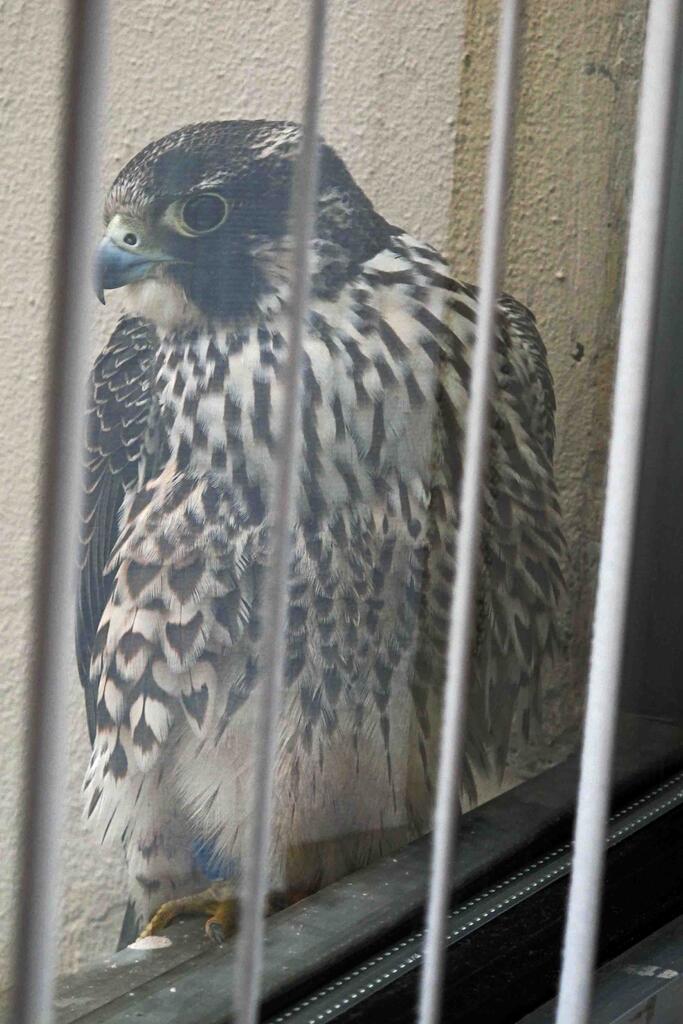
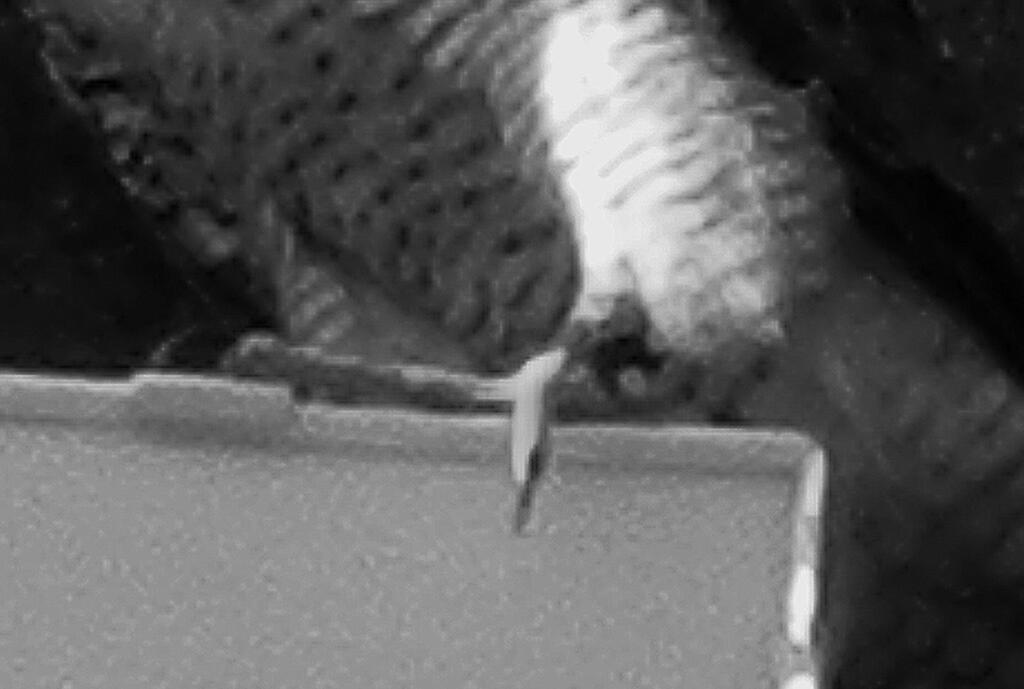
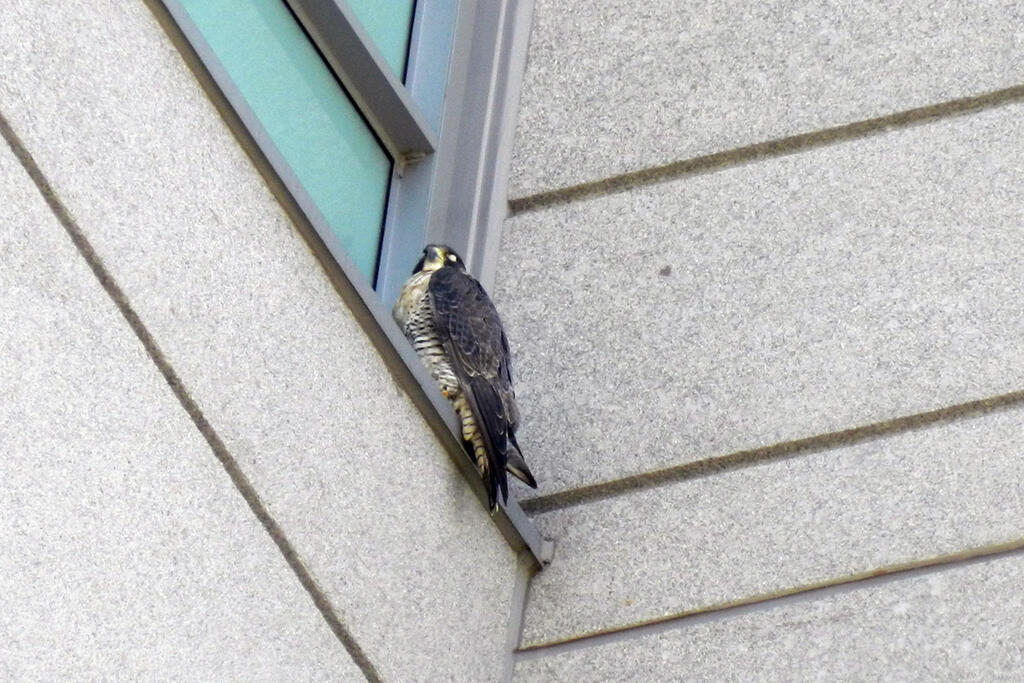
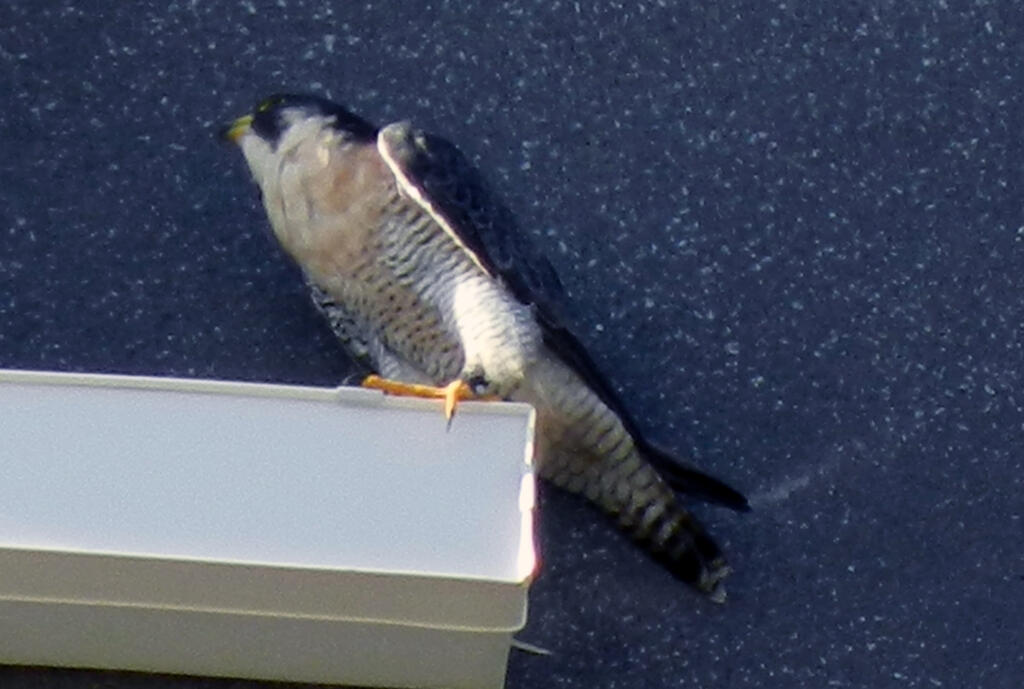
This afternoon, a peregrine falcon landed on the window sill of our 22nd floor condo on White Oaks Blvd in Oakville. I was able to take many photographs of him (or her). It is now 8:50 p.m. and s/he is still on the window ledge. S/he has a blue tapedband around the right ankle and seems very tame, not the least fussed about our watching through the blind. I am attaching a photograph. I also have a good video clip if you would like to post it somewhere.
Please advise if there is anything we can do to protect this beautiful bird.
Thank you
Jude and Frances Rand
Posted on October 24, 2012 10:22 am
October 12, 2012 - International, National and Local News
Frank Butson Reports:
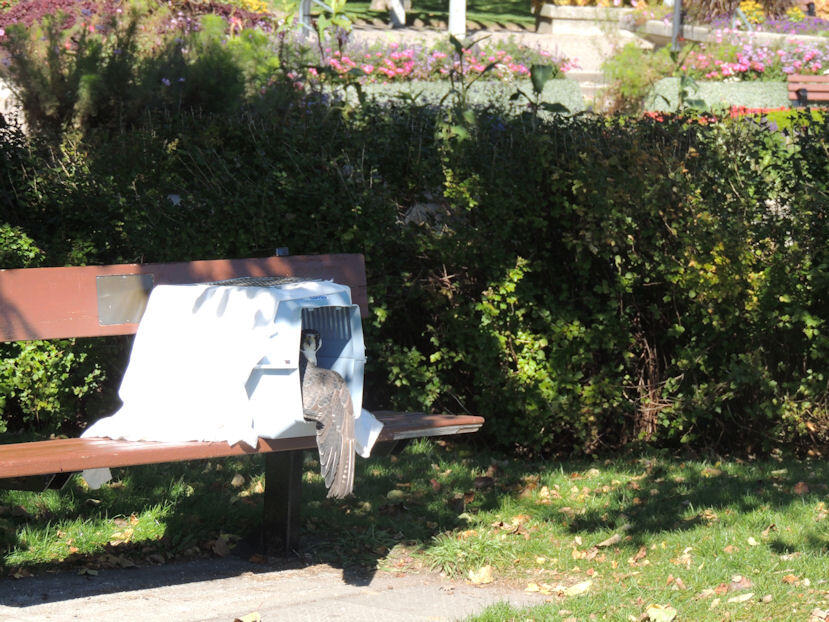
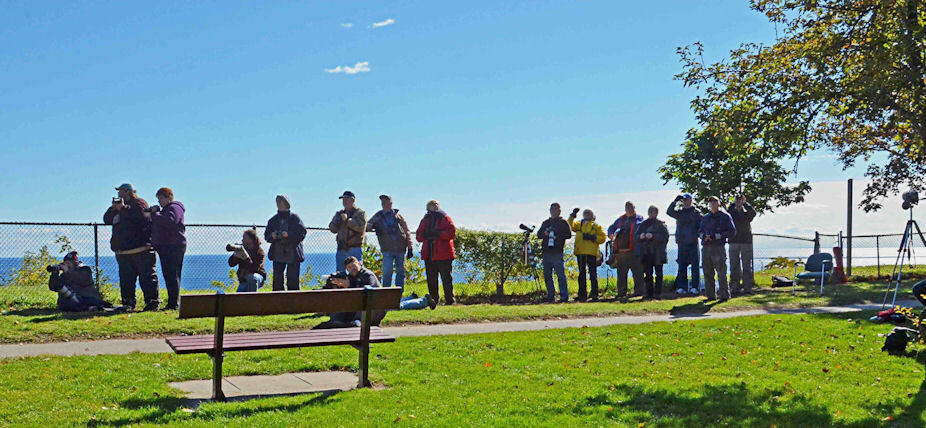
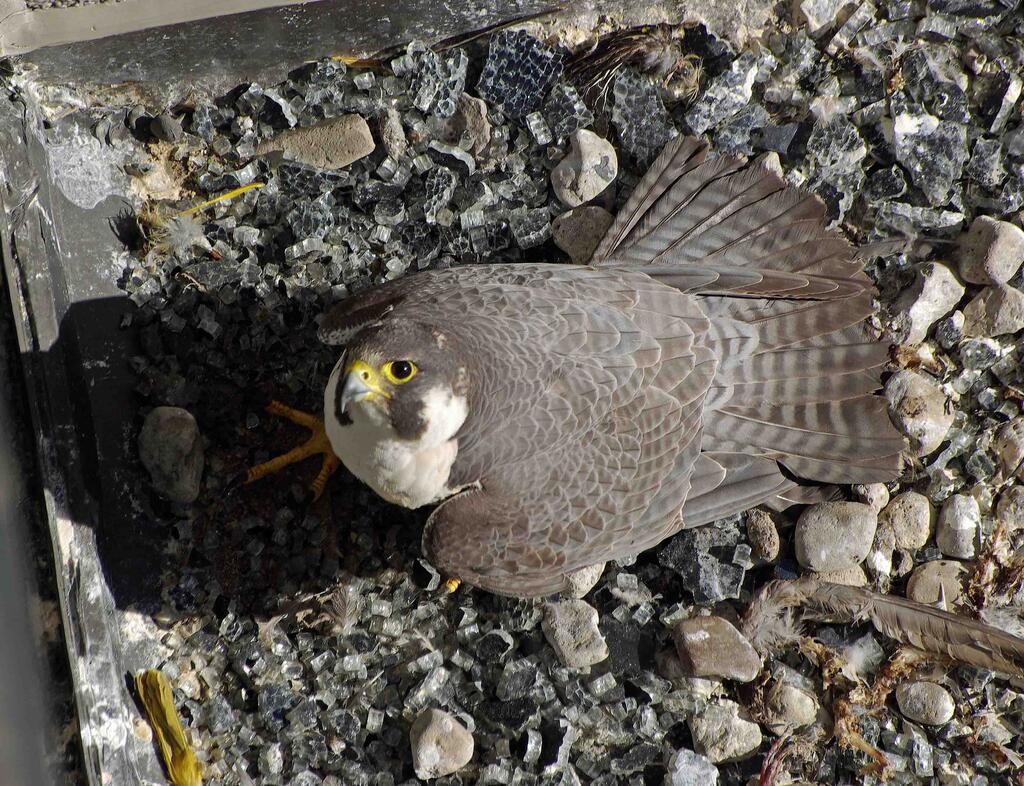
Mark Nash of the Canadian Peregrine Foundation called and asked if Id be interested in hosting the release of a Peregrine Falcon. At Rosetta McClain Gardens Raptor Watch in Scarborough, which is on a migration route. We have seen 91 Peregrine Falcons this season so far. This sub-adult female had been trapped in downtown Toronto behind a glass balcony. It was evaluated by the Toronto Wildlife Centre and deemed good to go, so the bird was transferred to CPF and Mark brought her to Rosetta to be released.
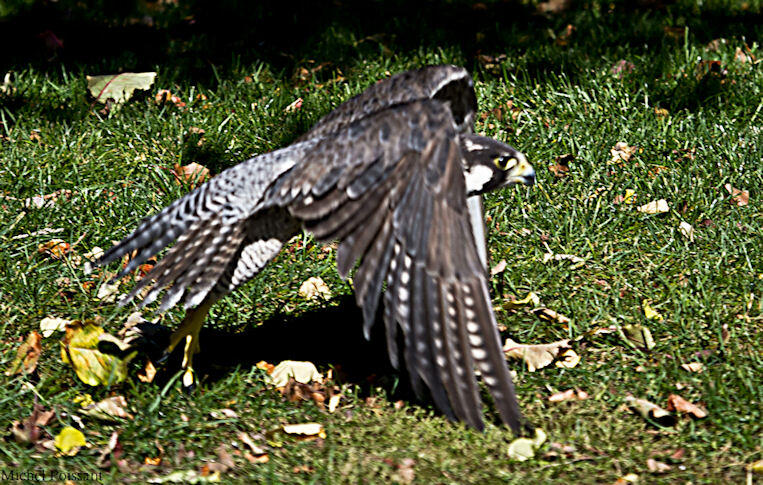
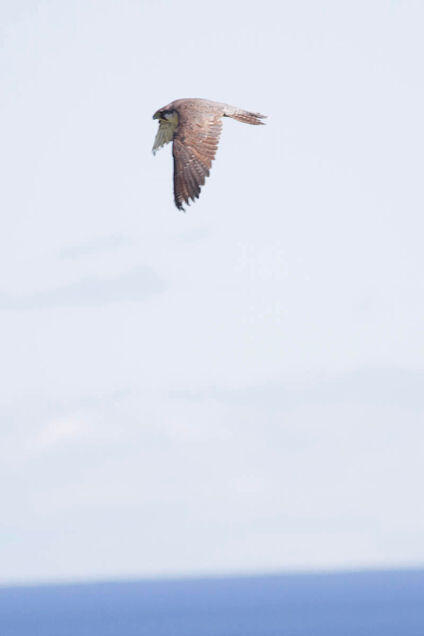
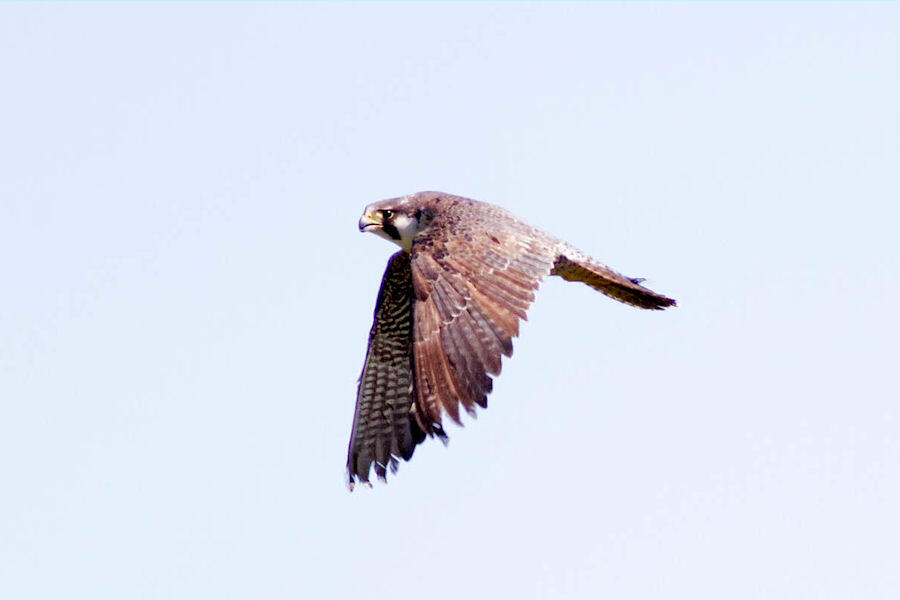
When the carrier was opened, the unbanded sub-adult female Peregrine sat in the box for a long period of time looking around, gathering herself, before finally flying out. She circled over Lake Ontario before heading off to the east. Awhile later a Peregrine went by flying west, very strong and somewhat out over the lake.
Much thanks to Mark for giving us the honour of seeing this magnificant Peregrine returned to where she belongs. Thanks to Toronto Wildlife Centre for treating the Peregrine and allowing CPF the honour of doing the release. Thanks to those gathered for not crowding the Peregrine. All of our keen photographers respected the process and allowed the bird to have a clear path to freedom.
Mark explained that when CPF does a release, unlike others we DO NOT throw (cast) the bird skyward, we allow the bird to decide when it wishes to fly. Casting the bird, after its been in a carrier/rehabbed possibly/upset by being caught in the first place is an accident waiting to happen. This bird, as the other release CPF did at Rosetta 2 years ago, went off without a hitch. The Peregrine flew freely when it decided to. It circled over the lake, finding its wings and then flew off strongly. Its a beautiful thing. May she have a safe journey.
Posted on October 14, 2012 3:51 pm
September 13, 2012 - International, National and Local News
Frank Butson Reports:
Mark Nash asked me to post this information:
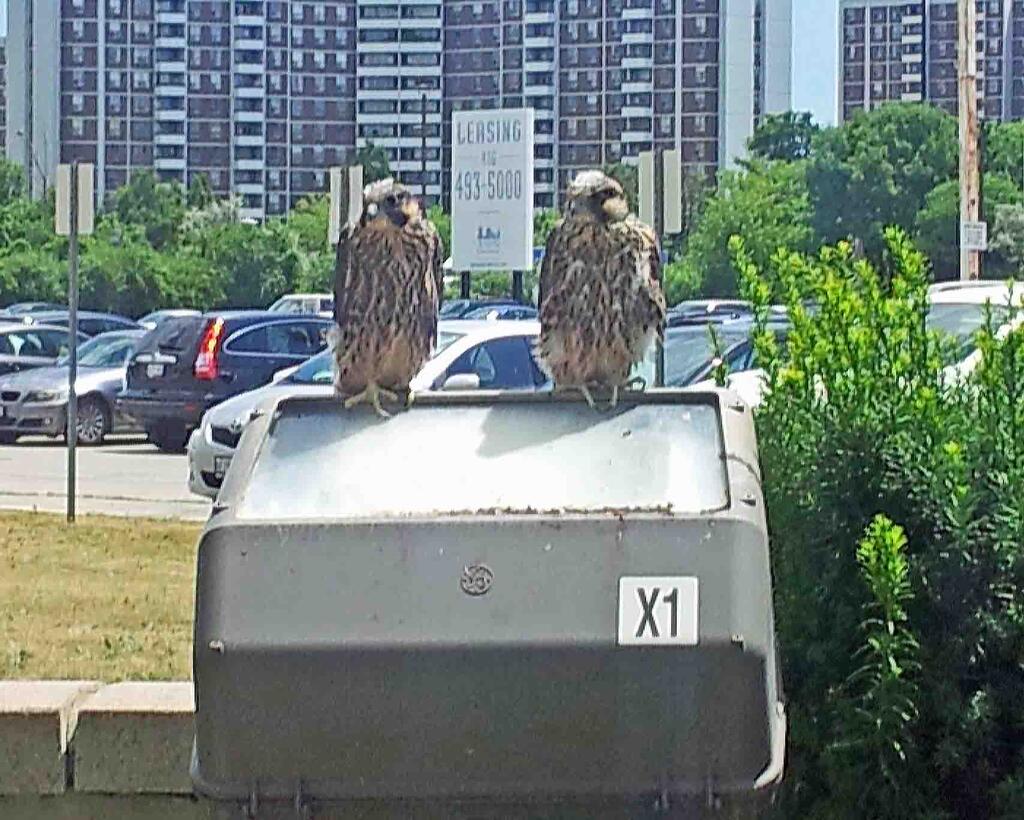
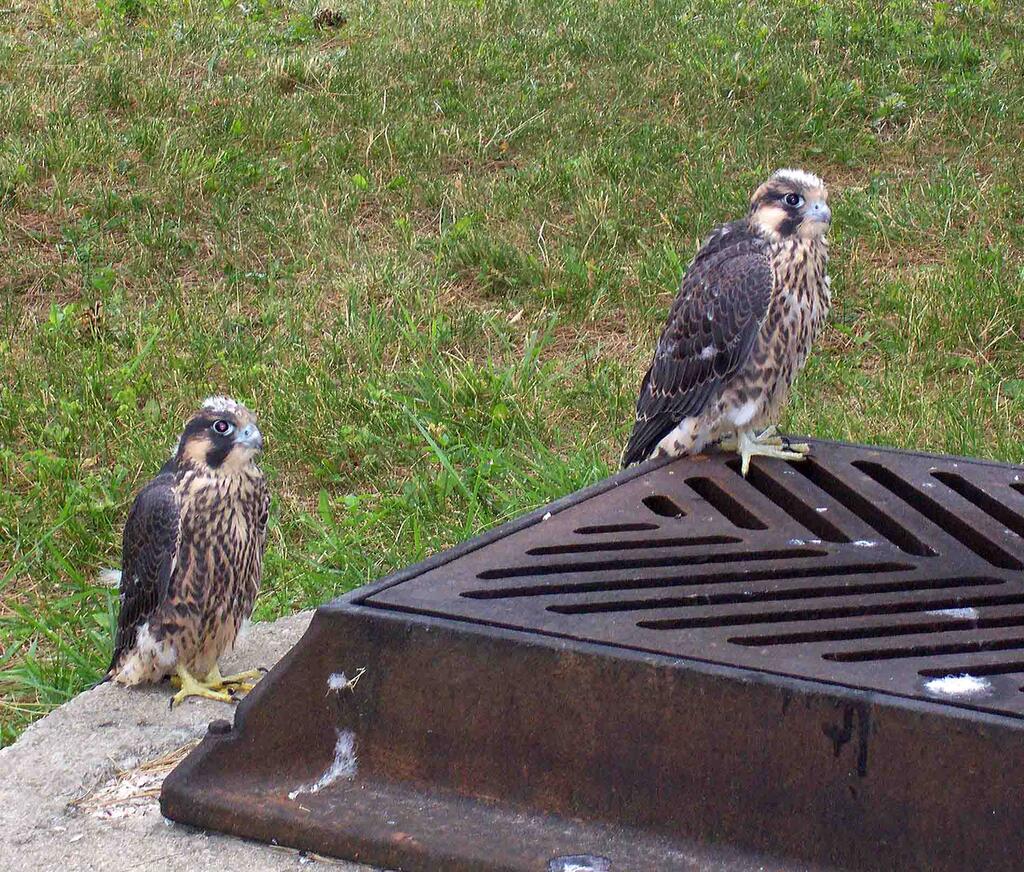
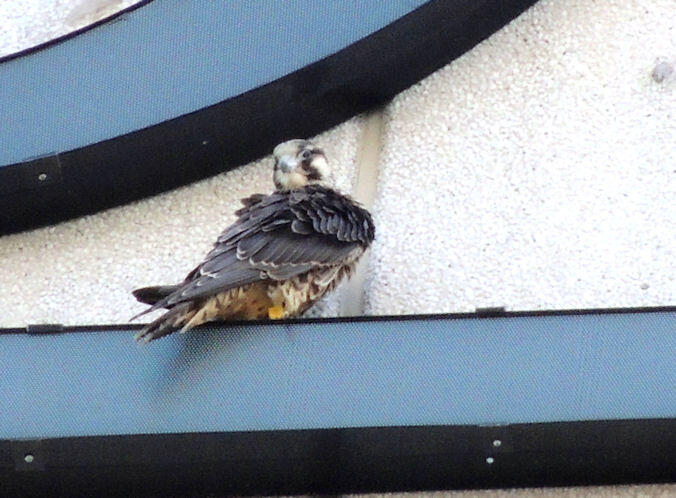
Thanks to Samantha and Dominic for the great photos of Ben and Len. The photos were taken shortly after the brothers had fledged. CPF was alerted to this by Dominic, and as per previous reports a CPF volunteer was dispatched to do a rescue. Shortly after the rescue both young Peregrines were banded at CPF Raptor Centre, where Ministry of Natural Resources staff was able to attend.
Ben was banded black over black R over 45(white letters and numbers) with yellow tape.
Len was banded black over black R over 38 (white letters and numbers) with blue tape.
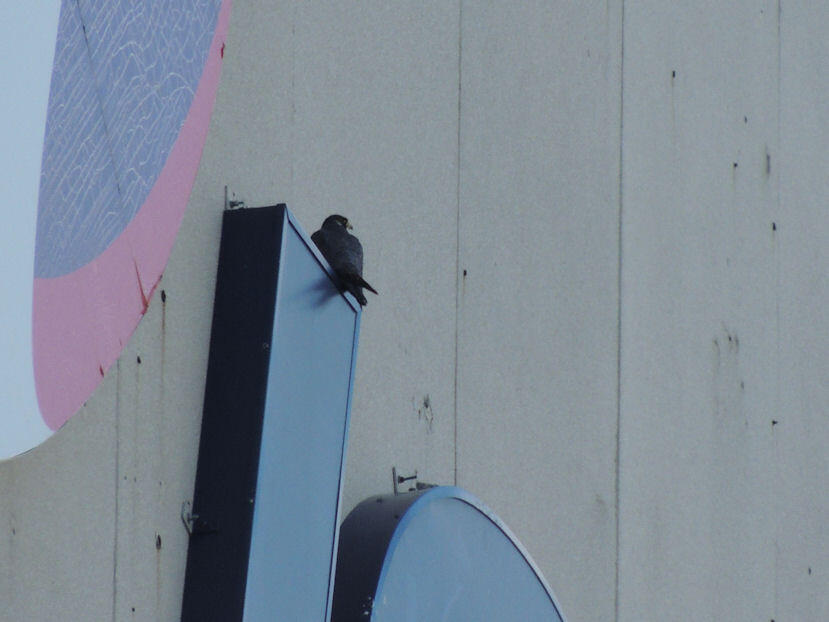
Thanks also to Dominic for the great shot of the resident adult female.
Somehow these photos and this information didnt get posted in all of the madness that was 2 surprise nests at ICICI and Waterloo.
Posted on September 13, 2012 7:58 pm
September 11, 2012 - International, National and Local News
Frank Butson Reports:
On Sunday Sept 9th, at the Rosetta McClain Gardens Raptor Watch, Rob Mueller, one of CPF’s volunteers visited me at my raptor watch in Scarborough. As luck had it, a juvenile Peregrine Falcon landed in the park and Rob was able to photograph it. Right away he noticed the yellow tape on the birds US Fish And Wildlife band, so we had a good clue it was a bird that CPF had banded this nesting season. After Rob sent the photo to CPF head office, the ID was confirmed to be BEN from the new ICICI nest at Don Mills and Eglinton.
The CPF volunteers were thrilled to learn Ben is alive and well and looking so handsome. Im sure ICICI staff will be excited to learn of this too!
Thanks to Rob Mueller for the great photos of Ben.


Posted on September 11, 2012 8:46 pm
September 03, 2012 - International, National and Local News
Tracy Simpson Reports:
The next stop on my list yesterday was to visit Claire at the Hilton Garden Inn and see whether I could identify for certain the Canadian male that she is bonded with. At first arrival, there wasn’t a bird to be found. I checked out all of her usual haunts and couldn’t find her. At this point, Bruce left for the east end of the city and I stayed on for a little while and checked out the area. Still nothing. As I was leaving and heading down the highway, I could see that a peregrine had just flown in to the Hilton!! I was already committed on my route and so I decided to stop back in on my way to the CPF Raptor Centre.
When I returned to the site, Claire was still in her favorite little corner of the Hilton and had one enormous crop going on. She was quite content to sleep and digest away the afternoon in the cubby hole and so I went on a cruise for her mate. When I reached the alt Hotel, I found him on the eastern side on top of the sign. He was facing the perfect direction for me to get an ID on him so I pulled out the scope and focussed in. He didn’t sit for very long as it was clear that he was looking for dinner. Within a few minutes, he was in the air and headed south on a mission. I can now say with a great degree of confidence that the resident male is black 35 over black Y making him Casper from Etobicoke and another offspring of Milton, our Brampton male, who has gone on to breed. I will continue to try and get photographic confirmation of this yet I am 99% assured that Casper is our man as I have seen both the 3 and the 5 on the band clearly. After about 15 minutes of being absent from the site, Casper returned to the alt Hotel and landed on the southern sign in the sunshine. Again, not staying long as his first hunt was unsuccessful, he was off this time to the east. He was clearly active around the Hilton as a huge flock of starlings that were feeding over there came in a massive cloud over to the parking gargage across from the alt Hotel looking to beat a hasty retreat. As I left, Claire was still hanging on her favorite ledge, Casper was gone from my sights and there was no sign of the single juvenile that the pair successfully raised this year. I will return again soon so check back for more updates!!
Posted on September 3, 2012 10:41 am
August 19, 2012 - International, National and Local News
Frank Butson Reports:
Reporting For Patty Gale
At 3:30 on Sunday 19th
I arrived at the ICICI nestsite I drove to the far end of the parking lot and oh joy!!, I spotted 3 falcons !!
Getting out my camera and zooming in for a closer look, I was able to ID Ben(from his yellow tape), who was under the D of the DeBeers sign.
I could not see a band on the falcon on the O of the Infor sign, but was quite certain it was Len, he had the same beige tips on his back feathers that his brother has. He never turned around for me to get a positive I.D.
An adult (the male ??) was on the ICICI sign
All were sleeping / preening and overall very still, just enjoying their time in the shade!
I stayed about an hour, and then drove around looking for the other adult - but found nothing
Patty Gale
Posted on August 23, 2012 1:23 pm
August 12, 2012 - International, National and Local News
Bruce Massey Reports:
I dropped in at the Don Valley ICICI nest site today to see how Ben and Len were coming along in their flight training skills. At first when I arrived I could only spot the unbanded resident adults on the nest building but the two boys were not to be found. Shortly after I discovered the adults, in from the west comes a juvenile screaming its head off and it flew right at the parents. I don’t know whether it was Ben or Len as I couldn’t see tape colour but the bird was flying with good control and confidence.
Posted on August 15, 2012 12:44 am
August 12, 2012 - International, National and Local News
Tracy Simpson Reports:
Today I stopped in at the Hilton Garden Inn nest site to check up on Claire, her mystery man and her young one. I first went to the alt Hotel where all three birds will roost throughout the day and found Claire on the eastern sign preening. I circled the building and found no other peregrines and so I left for the Hilton which we believe is the actual nest location. When I arrived, I found the juvenile on the south facing Hilton sign and I continued until I could see the northeast corner of the building. There is a ledge just below the roof level that both resident adults use very frequently as a roost spot. It was there that I found the resident male preening. He didn’t stay there long but instead ran down to the eastern edge and sat briefly before taking off. He took off flying due south on a very serious mission followed closely by his juvenile. I moved positions over to the alt hotel and sat watching Claire for a while. It wasn’t long before the adult male came in and landed on the east face of the hotel and was ee-chupping away. The two adults, one on the east side and one on the south, sat preening and relaxing until a wailing juvenile arrived and chased the male right off of his perch. He flew around the building, circled back and headed straight east out of sight. I left Claire and her young one to enjoy the afternoon at alt and the adult male to seek out a quiet place to the east.
Posted on August 15, 2012 12:38 am