- International, National and Local News
Frank Butson Reports:
Published On Mon May 16 2011

A bald eagle soars over Cootes Paradise along Hamilton’s Lake Ontario shore. Two bald eagles are nesting in a tall pine and could be making babies, but experts aren’t hopeful they will have eaglets this year.
JIM WILKES/TORONTO STAR
Jim Wilkes Staff Reporter
It appears there won’t be baby bald eagles along Hamilton’s Lake Ontario shore this year.
A young male eagle and his older female mate have been spotted snuggling in a nest atop a tall white pine in Cootes Paradise marsh throughout the spring.
But all that wooing hasn’t resulted in eggs, said Nick Kondrat of Burlington’s Royal Botanical Gardens.
“Judging the behaviour of the eagles, they’re not bringing food back to the nest,” he said.
“They’re not really hanging around as much as they would if there were young ‘uns in the nest.”
The male just might not be ready to deliver the goods, Kondrat said.
“You can tell by its feather patterns that it’s in the stage where it’s maturing into an adult eagle, but hasn’t quite reached that stage yet,” he explained. “We’re looking forward to next year.”
Had the majestic birds produced a brood, their young could have been the first homegrown bald eagles on the lake’s north shore in 50 years.
A century ago, bald eagles were a common sight along Lake Ontario. But toxic pesticides slowly killed off most of the population.
By 1980, only four bald eagle nests remained in southern Ontario, said Tys Theijsmeijer, RBG’s head of natural lands. There are now about 32 nests, including areas north of Toronto and near Peterborough, he said.
The birds, whose wingspan is more than two metres, were first spotted in the area in 2009 and naturalists have been hoping they’d start breeding to replenish the local eagle numbers.
Posted on May 16, 2011 11:54 pm
May 16, 2011 - International, National and Local News
Frank Butson Reports:
Once nearly extinct, the California condor nears new milestones

 Almost 25 years after the California condor went extinct in the wild and dwindled to just 27 birds in captivity, North America’s largest flying bird is on the verge of a watershed moment: Its total population is projected to hit 400 this spring, including 200 birds thriving in the wild.
The projections come as curators are reporting a successful hatching season at breeding centers in California and elsewhere.
“At the end of the breeding season, we should be at 400 if all goes to projection,” said Michael Mace, curator of birds at the San Diego Zoo Safari Park. “At the end of this year, we could have 200 birds in the wild. Both would be significant milestones.”
The 400 mark hasn’t been seen since the 1920s or 1930s, Mace said.
The condor population is currently 394, including 181 in the wild — a marked improvement since 1987 when the condor was wiped out in the wild and only 27 lived at the San Diego Zoo, he said.
The success hasn’t been without new challenges.
While the nearly 200 birds in the wilderness are resuming feeding activities last seen during the Lewis and Clark Expedition of the early 1800s, the condor is now ingesting the toxin DDE when eating marine carcasses, Mace said.
The toxin causes the shell of condor eggs to thin, so conservationists are replacing the thin-shelled eggs laid in the wild with thicker-shelled eggs from breeding centers, Mace said. The thin-shelled eggs are taken to incubators in breeding facilities for hatching, he said.
“Condors are doing what they normally do: They feed on marine animal carcasses,” Mace said. “We are excited that condors are doing activities that Lewis and Clark observed more than 100 years ago. But it turns out these marine animals are feeding on DDE, and now the condors are feeding on them, and the shells of their eggs are thin and break.”
DDE is formed when the pesticide DDT breaks down. DDT is banned in the United States, but the chemical enters the environment through its use in other countries.
“Some of these factors we’re dealing with right now weren’t factors five, 10 years ago,” Mace said.
For example, California condors are now being vaccinated for the West Nile virus, Mace said.
The California condor lives in the isolated areas of California, Arizona and Baja California, Mexico, where mankind reintroduced the birds after they were effectively eradicated from the wilderness, according to Mace.
They weigh up to 29 pounds, have a wingspan reaching up to 9½ feet and live up to 60 years. Their habitat is wooded mountains and scrub lands, according to the San Diego Zoo.
For all the worldwide attention the species enjoy, the condor’s feeding habit is among the most inelegant: They are vultures that feed on carrion, large and small. They will eat big animals — deer, cattle, sheep. And they will eat small animals — rodents, rabbits, fish. The carrion has sometimes been killed by a hunter’s gunshot. The lead from the buckshot can also poison the condor, Mace said.
The condors gorge themselves on two to three pounds of carrion at a time and can fast for several days until they find another carcass.
The ignominious status of scavenger aside, the condor still holds the high stature of flagship species, which the polar bear also enjoys.
In the ecosystem, the California condor serves as Mother Nature’s cleanup crew, feeding on dead animals to prevent them from spreading disease to other wildlife and plants.
Because the vulture is active in parts of California, Arizona and Mexico, about 50 other endangered animals and plants are able to thrive — thanks to the condor, Mace said.
Four breeding centers are now hatching condor eggs: the San Diego Zoo, the zoo’s Safari Park, the Oregon Zoo in Portland, and the World Center for Birds of Prey in Boise, Idaho, Mace said.
The hatching season runs from March until May, he said.
“This is the peak season for us,” Mace said.
The warmer weather in Oregon has led to a banner year for condor eggs at the Oregon Zoo, with a total of nine chicks so far, the most since the zoo began participating in the condor conservation effort in 2004, said Kelli Walker, a condor keeper at the zoo’s Jonnson Center for Wildlife Conservation.
She also credited the growing maturity of the zoo’s condors.
“It sounds silly, but we had some really nice weather,” Walker said. “This year, we had some of the first eggs because they bred earlier.
“Oregon is having the biggest year we have ever had,” she added. “We got eight eggs in eight days.”
Posted on May 16, 2011 3:16 pm
May 16, 2011 - Windsor - Ambassador Bridge
Dennis Patrick Reports:
Well, the waiting is over, Dennis and I definitely saw at least one chick yesterday afternoon on the nest site. Voltaire was on the nest site while Freddie was sitting on the ledge, in seconds Voltaire flew off the nest and back again with food and started to feed a chick. We were there for about two hours, after Voltaire was done feeding the chick, she took out the garbage while Freddie stayed on the nest ledge. Thank you to Mark from CPF for being so happy for us in Windsor knowing that we finally have a hatch. Now we wait for a banding day date. Gwen & Dennis
Posted on May 16, 2011 6:48 am
May 15, 2011 - Toronto - King Street
Linda Woods Reports:
More rain today, cold blustery winds. King St peregrines have tucked the little ones in the corner under the view of the camera. I’ll try again tomorrow for status update.
Last viewing, two hatches, two eggs.
Posted on May 15, 2011 5:22 pm
May 15, 2011 - Toronto - Sheraton Centre
Mark Nash Reports:
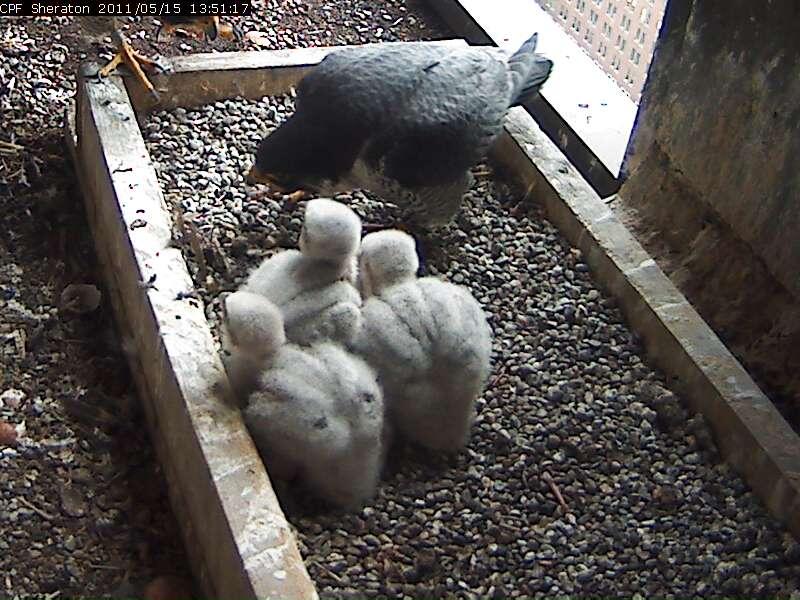
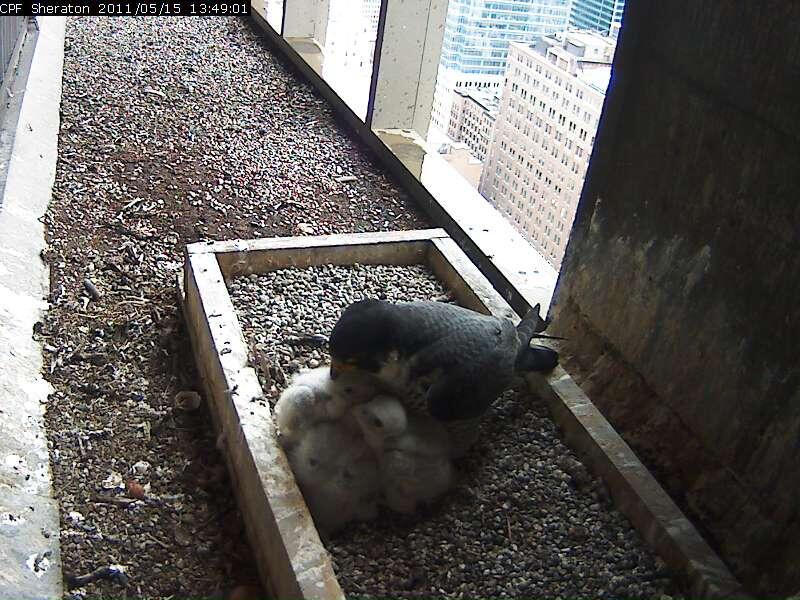
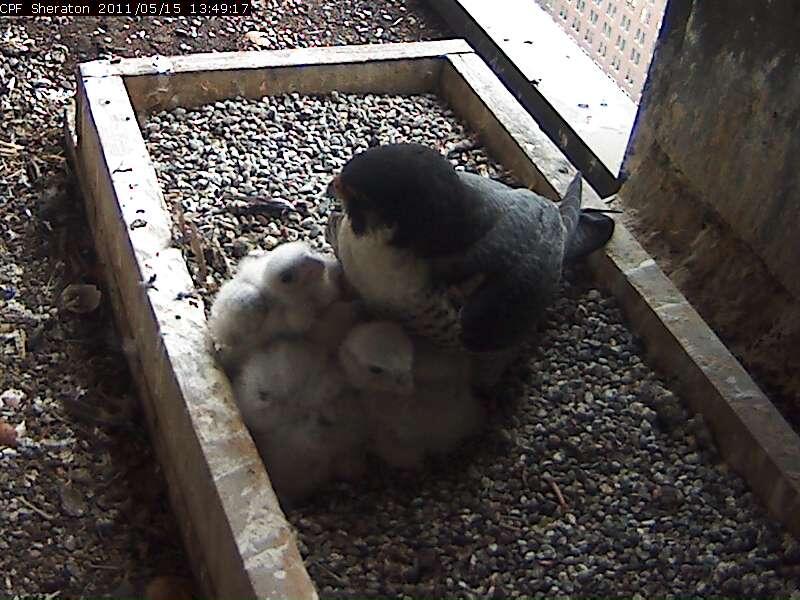
Captured some great shots moments ago with Tiago very confused and frustrated while he is trying to figure out how he can cover and brood his hatchlings from the fowl weather conditions today,, with high gusty winds, cold temps, and more rain!!
Seconds later, RM also attended (see in the top left part of the photo) to give him some instructions and direction as to how its to be done.
Still, the hatchlings are just to big to actually cover them all at this age, so the best plan of action is to try and shelter them from the cold blowing winds and driving rain.
Toronto’s weather today is terrible, with unreasonably cold damp conditions, driving rain and blustery winds!
Posted on May 15, 2011 2:02 pm
May 15, 2011 - Burlington - Lift Bridge
CPF Postmaster Reports:
Good news,, we have worked out a banding date for the Burlington life bridge nest site.
Booked for Tuesday May 31st, with banding itself to take place at approx. 11am.
Arrival at 10AM., with extraction of the chicks from the nest box by 10:30 AM and banding around 11am.
Posted on May 15, 2011 11:47 am
May 14, 2011 - Windsor - Ambassador Bridge
Dennis Patrick Reports:
Yesterday we went down to the bridge and watched the two adults, for almost two hours, Voltaire was busy sitting and working away on the nest site while Freddie was moving from the top of the “R” on Ambassador then to the cable, then on to the Church Steeple, then to the “A” and when we left he was sitting on the ledge. Thank goodness both of us were using our binoculars, I kept watching Voltarire while Dennis kept his eyes on Freddie. Still no sign of balls of fluff yet. She was very busy moving around but we just couldn’t see anything except her moving around. We will keep you informed of anything we see down there. We are definitely behind behind the hatch schedule of last year but it has been a flucky Spring.
Gwen and Dennis
Posted on May 14, 2011 11:50 am